
Clearing a shipment into Saudi Arabia, the UAE, Qatar or Kuwait is rarely delayed by the chemistry itself. It is delayed by paperwork. GCC import documentation for specialty chemicals covers a predictable set of files – certificate of analysis, safety data sheet, certificate of origin, conformity and shipping documents – and most demurrage charges trace back to one of them being missing, inconsistent or issued in the wrong name. This guide walks through what each document is for, what reviewers actually look at, and how buyers can prepare a file set that moves through customs and internal QA without rework.
GCC Import Documentation: The Core Document Set
For a typical drum shipment of a fine chemical such as tetrabutylammonium bromide, the document pack usually contains a commercial invoice, packing list, bill of lading or air waybill, certificate of origin, certificate of analysis (COA), safety data sheet (SDS), and, depending on the destination and the product category, a certificate of conformity or a product registration reference. Dangerous goods add a dangerous goods declaration and transport classification details.
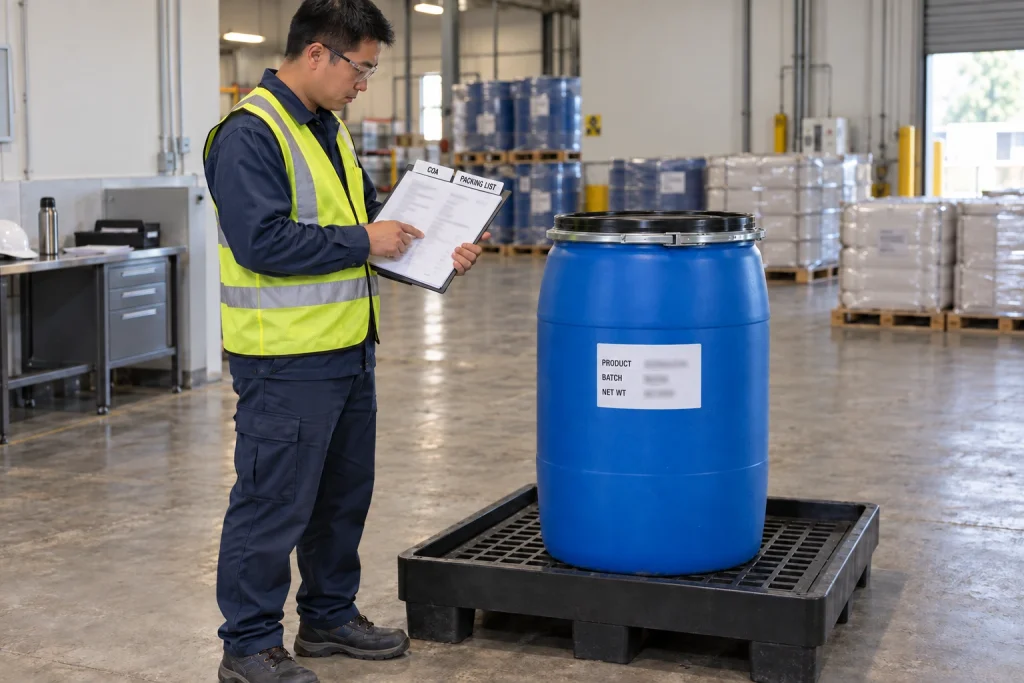
The single most common problem is not an absent document but an inconsistent one. Product name, grade, CAS number, batch number, net weight and package count should read identically across invoice, packing list, COA and label. Customs officers and terminal inspectors compare these fields directly, and a mismatch between a COA that says 25 kg drums and a packing list that says 25 kg bags is enough to hold a container. Before shipment, it is worth running a simple cross-check of those six fields across every document in the pack.
Certificate of Analysis: What Customs and QA Teams Check
The COA is the quality anchor of the shipment. It should identify the product by full chemical name and CAS number, state the batch or lot number, give the manufacturing and retest or expiry dates, and list each specification parameter with its limit, the result obtained and the test method used. For quaternary ammonium salts that typically means assay by two-phase titration or chromatography, water content by Karl Fischer, residue on ignition or ash, free amine, and appearance.
A few points make a COA easier for a receiving QA team to accept. Results should be actual measured values rather than a bare “conforms”. Methods should be named, since an assay by titration and an assay by HPLC are not interchangeable. The batch number on the COA must match the drum labels exactly, including any prefix. Where a customer specification differs from the standard product specification, the COA should be issued against the agreed customer specification so that no interpretation is needed at goods-in. Our article on COA parameters for quaternary ammonium salts goes through these fields in more detail.
Identity checks are also easier when the CAS number is unambiguous. For tetrabutylammonium bromide, CAS 1643-19-2 resolves to a single public record that a reviewer can verify in seconds, which is why CAS numbers belong on both the COA and the label.
Safety Data Sheets, Labels and Transport Classification
SDS expectations across the GCC follow the GHS 16-section format. Practical requirements that buyers should confirm before the goods leave the plant include an English SDS at minimum, with Arabic increasingly requested by institutional and government end users; a revision date recent enough to be credible, since a sheet dated many years back invites questions; and GHS classification, pictograms and hazard statements that match the shipping documents and the drum labels.
Transport classification drives cost and routing. Many quaternary ammonium salts ship as non-regulated solids, while solutions, hydroxide grades and some concentrates are regulated and may be considered corrosive or marine pollutants. The UN number, proper shipping name, packing group and any marine pollutant marking must be consistent across the SDS section 14, the dangerous goods declaration and the container markings. Where a product is non-regulated, a short written statement to that effect from the manufacturer often prevents unnecessary questions at the port. Buyers moving hazard-classified material through Gulf terminals may also find our notes on shipping hazardous chemicals to Jebel Ali and Gulf ports useful when planning lead times.
Certificates of Origin, Conformity and Halal Files
The certificate of origin is normally issued by a chamber of commerce in the exporting country and may require legalisation depending on the destination and the importer’s arrangements. It should carry the same consignee details as the bill of lading, since a mismatch in the consignee name or address can require reissue, which is slow.
Conformity requirements vary by product category and by country. Several GCC markets operate conformity assessment schemes administered through national standards bodies, and cosmetic, food-contact, feed and biocidal products are generally subject to additional registration or notification before the first shipment rather than at the border. Because these schemes are updated periodically, importers should confirm current requirements with their local agent or the relevant authority for each specific product code rather than relying on what applied to a previous shipment. The regulatory background is covered further in our overview of GSO and SASO considerations for specialty chemical imports.
Halal certification is commonly requested for ingredients destined for food, feed, oral care and some personal care uses. It is usually issued by an accredited certification body and relates to the manufacturing site and product, so it needs to be arranged upstream with the manufacturer and cannot be produced at short notice. The same applies to free sale certificates and manufacturer declarations covering animal origin, BSE/TSE status, allergens or GMO content, which buyers should request at the quotation stage rather than after the order is placed. Products across the catalysis and synthesis chemicals range are usually straightforward in this respect, but the documentation still takes time to assemble.
Why AXIA CHEM
AXIA CHEM supplies quaternary ammonium salts, phase transfer catalysts and synthesis intermediates to buyers across the Middle East, and prepares the export document pack as part of every order rather than as an afterthought. That means batch-specific COAs with measured results and stated methods, GHS-format SDS in English, consistent labelling and packing documentation, and support in obtaining certificates of origin and supplementary declarations where the destination requires them. Technical questions about specifications, transport classification or documentation are answered by people who handle the product, and sample quantities such as tetrabutylammonium bromide (TBAB) can be shipped with the full document set so that your regulatory and QA teams can review it before a commercial order is placed. To discuss a specific product, specification or destination market, contact the AXIA CHEM team.
Regulatory disclaimer: These products are supplied for research, formulation development, industrial and non-regulated applications. Final suitability for pharmaceutical, oral care, cosmetic, food-contact or biocidal applications shall be verified by the buyer according to local regulations. AXIA CHEM does not claim that any product is FDA approved, USP/EP certified, GMP grade or approved for any specific regulated end use unless otherwise confirmed in writing with supporting documentation.