
When a shipment of quats arrives at your warehouse, the certificate of analysis is the first and often the only document that tells you whether the material inside the drums matches what you ordered. Reading a quaternary ammonium salt COA correctly means knowing which parameters actually predict performance, which ones flag process-related impurities, and which acceptance limits are worth negotiating into your supply agreement. This guide walks through the typical test items you will see on certificates for common quats such as tetrabutylammonium bromide (CAS 1643-19-2) and hexadecyltrimethylammonium bromide (CTAB, CAS 57-09-0), and explains what each number means for a purchasing or QC team.
Assay and Active Content: The Headline Number
The assay is the percentage of the quaternary ammonium compound itself in the delivered material, and it is the parameter most directly tied to dosing. For solid quats, assays of 98 percent or 99 percent minimum are common commercial specifications, while liquid or solution grades state the active content of the solution instead.
Two analytical approaches dominate. Argentometric titration determines the halide counterion (bromide or chloride) and back-calculates the salt content; it is simple and reproducible, but it counts any halide-bearing impurity together with the product. Two-phase titration against an anionic surfactant such as sodium lauryl sulfate measures the cationic species directly and is therefore more specific to the quat itself. A well-prepared certificate states which method was used, because the two can give slightly different values on the same batch. If your application is sensitive to true cationic content – phase transfer catalysis stoichiometry, for example – it is reasonable to ask the supplier which method sits behind the assay figure.
Water Content and Loss on Drying
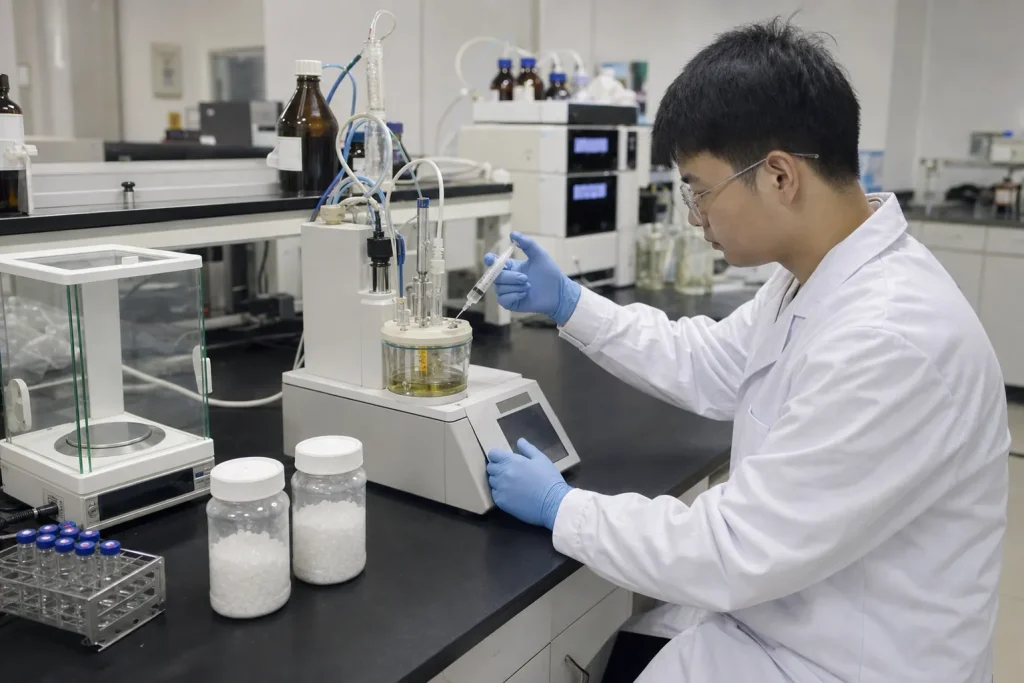
Most quaternary ammonium salts are hygroscopic to some degree, so moisture is usually the second number a buyer should check. Karl Fischer titration is the standard method because it measures water specifically; loss on drying is sometimes reported instead, but it also captures volatile solvents and can understate bound water in hydrates.
Typical limits for anhydrous solid quats fall in the 0.5 to 1.0 percent range. Moisture matters for three reasons: it dilutes the active content, it can promote caking during storage in humid coastal climates such as the Gulf region, and in water-sensitive chemistry – anhydrous phase transfer reactions or electrolyte formulations – even modest water levels may be evaluated as a process risk. For products supplied as defined hydrates, the certificate should distinguish water of crystallization from excess surface moisture.
Impurity Parameters: Free Amines, Residual Solvents and Related Salts
Quats are made by quaternizing a tertiary amine with an alkyl halide, so the impurity profile mirrors the process. Residual free amine is the most characteristic impurity: it can carry odor, raise toxicity considerations in hygiene-related uses, and consume acid in downstream chemistry. Certificates often cap free amine content or control it indirectly through a pH specification on an aqueous solution, since unreacted amine shifts the solution alkaline.
Other entries you may see include residual alkyl halide or solvent (commonly controlled by GC where the end use requires it), inorganic halide salts left from synthesis, sulfated ash as a check on non-volatile inorganic residue, and heavy metals for grades intended for more demanding applications. Not every certificate carries every test – a technical grade destined for oilfield water treatment is usually specified more simply than a material that will be evaluated in personal care or pharmaceutical development work. The right question is not “why is this COA short” but “does this COA control the impurities that my process cares about”.
Appearance, Solubility and Identity Checks
Physical parameters round out the document. Appearance (typically a white to off-white crystalline powder for solid quats), melting point or melting range, clarity and color of an aqueous solution, and pH of a defined solution all serve as quick consistency checks between batches. Identity is confirmed where required by IR spectrum comparison or by wet-chemistry tests for the ammonium cation and the halide anion. These tests rarely fail in isolation; their value is in catching gross errors such as mislabeled drums or cross-contamination before material reaches production.
Using the COA in Procurement: Practical Checkpoints
A few habits make certificates genuinely useful rather than a filing formality. First, agree the specification before the first order, so the COA is checked against a contract rather than against whatever the supplier prints by default. Second, compare certificates across batches: a drifting assay or rising moisture trend tells you more than any single sheet. Third, match parameters to the application. A buyer sourcing tetrabutylammonium bromide for phase transfer catalysis will care most about assay method and water content, while a formulator evaluating CTAB as a cationic surfactant may weight free amine, solution clarity and consistency of chain-length distribution more heavily. Finally, retain samples and certificates together, so any later dispute can be resolved against the delivered batch.
The same logic extends across the wider family of quaternary ammonium salts and related phase transfer catalysts: the certificate is only as valuable as the fit between its test items and your process requirements.
Why AXIA CHEM
AXIA CHEM supplies quaternary ammonium salts and specialty fine chemicals to industrial buyers across the Middle East and worldwide. Every shipment leaves with a batch-specific certificate of analysis, and our technical team is available to align specifications with your application before you commit to volume – including agreeing assay methods, moisture limits and impurity controls in writing. With flexible pack sizes from evaluation samples to full container loads and responsive communication across time zones, we aim to make specification-driven sourcing straightforward. Contact us at axiachem.com/contact-us to discuss your COA requirements and request documentation for review.
Regulatory disclaimer: These products are supplied for research, formulation development, industrial and non-regulated applications. Final suitability for pharmaceutical, oral care, cosmetic, food-contact or biocidal applications shall be verified by the buyer according to local regulations. AXIA CHEM does not claim that any product is FDA approved, USP/EP certified, GMP grade or approved for any specific regulated end use unless otherwise confirmed in writing with supporting documentation.