
Ethyl ascorbic acid stability is a practical purchasing concern when a formulation must remain consistent through manufacture, transport and storage. A raw material specification alone cannot establish the shelf life of a finished serum, cream or other development formula. Buyers need to connect ingredient identity and batch quality with the actual pH, processing conditions and packaging used in their project.
3-O-Ethyl-L-ascorbic acid, CAS 86404-04-8, may be evaluated as a vitamin C derivative in formulation development. Its identity is documented in PubChem, but an identity record does not establish performance in a particular product. A useful sourcing discussion therefore separates what the supplier can document from what the formulator must demonstrate experimentally.
Ethyl Ascorbic Acid Stability Starts with a Defined Formula
Stability is broader than whether a sample still looks acceptable. An evaluation may include retained ingredient content, appearance, odor, pH and physical uniformity. These observations answer different questions. An unchanged color does not prove that the original ingredient content has been maintained, while discoloration should prompt investigation rather than an automatic conclusion about its cause.
Before comparing samples, establish a complete formula and a repeatable preparation method. Record the ingredient concentration, water quality, solvent system, order of addition and mixing conditions. Keep a reference sample and define acceptance criteria before starting the study. Changing several variables between batches makes it difficult to identify why one sample behaves differently.
For purchasing, request the current specification and a batch certificate of analysis for 3-O-Ethyl-L-Ascorbic Acid. Review identity, assay basis and any reported water or impurity measurements. Ask which analytical methods support those results. A high assay value can support raw material evaluation, but it does not replace compatibility testing in the finished formulation.
Evaluate pH in the Complete Formulation
There is no sound basis for assigning every formulation the same operating pH simply because it contains the same vitamin C derivative. The surrounding ingredients, solvent composition and intended product characteristics all matter. Obtain the supplier’s technical guidance, then treat any suggested range as a starting point for trials in the actual system.
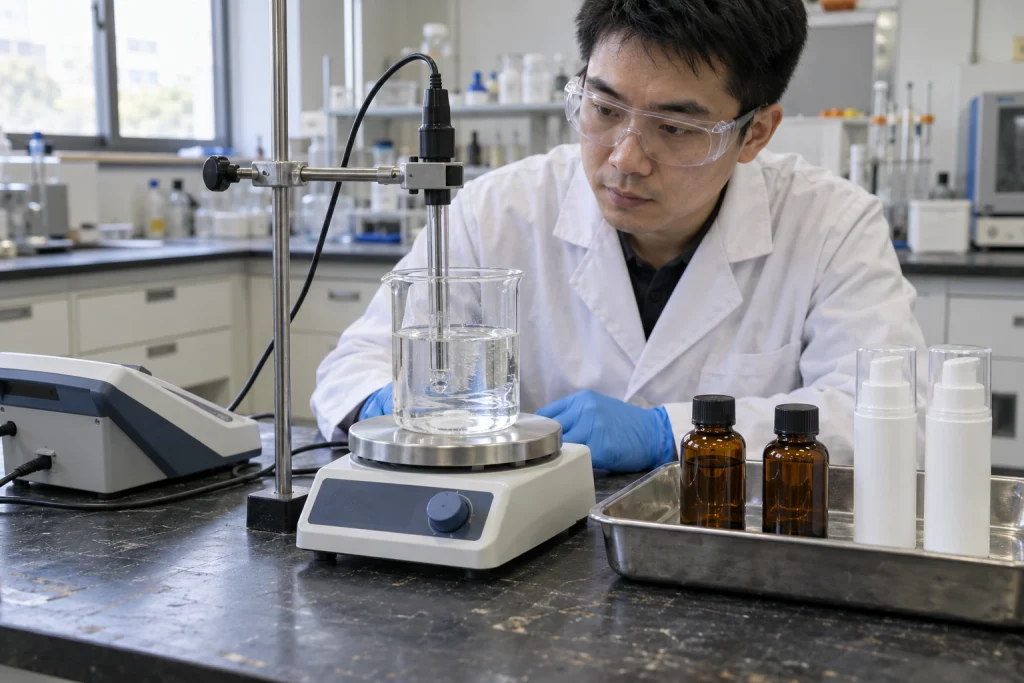
Measure pH using a method suited to the sample, with consistent temperature and preparation conditions. If dilution is needed for measurement, document it and use the same procedure throughout the study. Compare initial results with later readings rather than relying only on the value recorded immediately after mixing.
When adjusting pH, avoid exposing a concentrated portion of the ingredient to a strong local excess of acid or alkali. Use a controlled addition procedure and check the final mixture after equilibration. Trial batches can compare nearby pH settings while holding other variables constant. Track assay and appearance alongside pH so that a stable reading is not mistaken for complete chemical stability.
Control Processing Heat and Storage Exposure
Temperature history includes more than the final warehouse setting. Dissolution, heated mixing, holding before filling and shipment may each contribute exposure. Record these stages in development batches. If the material can be incorporated during a cooler processing stage without compromising dissolution or uniformity, that approach may be evaluated against the existing method.
Do not select a universal maximum processing temperature without supporting data for the formula and exposure time. A short manufacturing step and prolonged storage are different conditions. Compare realistically prepared batches, and use an analytical method capable of distinguishing the ingredient from relevant degradation products where practical. Otherwise, apparent assay retention may be difficult to interpret.
For Middle East and other warm-market projects, discuss the anticipated transport and storage route with logistics colleagues. Testing can include elevated-temperature screening and temperature cycling when relevant to the product. Such screening helps identify weaknesses, but it does not automatically establish a commercial shelf life. Continue real-time observation in the intended pack and retain records linking each sample to its batch and storage conditions.
Test Packaging with the Formula It Will Contain
Light exposure, oxygen contact and interactions with packaging should be considered together. Opaque containers, suitable barrier materials or dispensing systems that limit repeated air exchange may be evaluated. None should be treated as a guaranteed solution before testing. The closure, headspace, fill level and dispensing pattern can influence the conditions experienced by the formula.
Compare candidate packs using the same batch wherever possible. Include the proposed commercial closure and any liner, pump or dropper components. Observe leakage, loss of mass, changes in appearance and dispensing performance as well as chemical measurements. Testing only in laboratory glassware leaves questions about the final packaging unanswered.
A practical comparison includes unopened samples and, where appropriate, samples subjected to a defined opening or dispensing routine. Keep exposure conditions documented and avoid drawing conclusions from a single container. Our ethyl ascorbic acid formulation overview provides related ingredient context. Buyers comparing other formulation and performance ingredients should likewise evaluate each material within its complete formulation.
Why AXIA CHEM
AXIA CHEM welcomes sourcing discussions that connect supply requirements with practical quality evaluation. Share the required quantity, target specification, destination, packaging preference and sample needs so that availability and documentation can be reviewed for the specific inquiry. Ask for the current certificate of analysis, safety data sheet and applicable handling information before approving a purchase.
A clear inquiry also supports efficient technical communication: identify which stability questions require supplier input and which will be assessed in your laboratory. Confirm batch requirements, lead time and any additional testing in writing. To discuss material supply and evaluation needs, contact AXIA CHEM for ethyl ascorbic acid sourcing.
Regulatory disclaimer: These products are supplied for research, formulation development, industrial and non-regulated applications. Final suitability for pharmaceutical, oral care, cosmetic, food-contact or biocidal applications shall be verified by the buyer according to local regulations. AXIA CHEM does not claim that any product is FDA approved, USP/EP certified, GMP grade or approved for any specific regulated end use unless otherwise confirmed in writing with supporting documentation.