
Formulators looking for a dependable route to vitamin C benefits without the stability headaches of the parent molecule often turn to 3-o-ethyl ascorbic acid. This etherified derivative, also written as 3-O-Ethyl-L-Ascorbic Acid or simply ethyl ascorbic acid, has become one of the most widely used vitamin C derivatives in brightening serums, essences and creams. For B2B buyers, it combines a well-understood performance profile with far more forgiving handling than L-ascorbic acid, which makes it a practical choice for products destined for warm-climate markets such as the Middle East and Southeast Asia.
What Is 3-O-Ethyl-L-Ascorbic Acid?
3-O-Ethyl-L-Ascorbic Acid (CAS 86404-04-8) is a derivative of L-ascorbic acid in which the hydroxyl group at the 3-position is capped with an ethyl ether. That single modification changes the behavior of the molecule in important ways. The 3-position hydroxyl is the most acidic and most oxidation-prone site on ascorbic acid, so blocking it protects the molecule from the rapid degradation that plagues pure vitamin C in aqueous systems.
The ether bond is also relatively resistant to hydrolysis, which distinguishes this material from ester-type derivatives such as ascorbyl glucoside or magnesium ascorbyl phosphate. In the skin, the derivative is generally described as being converted to free ascorbic acid, which is why it is positioned as a bioavailable vitamin C source. As with any cosmetic active, specific efficacy claims should be supported by the brand’s own testing rather than assumed from the ingredient alone.
Typical commercial material is a white to off-white crystalline powder with good solubility in water, ethanol, glycols and some ester oils. This amphiphilic character gives formulators unusual freedom: the same active can be evaluated in aqueous serums, hydroalcoholic toners, emulsions and even anhydrous systems.
Why Stability Matters: Ethyl Ascorbic Acid vs L-Ascorbic Acid
Pure L-ascorbic acid oxidizes quickly when exposed to air, light, heat, trace metals or neutral-to-alkaline pH. The visible result is the familiar yellowing and browning of vitamin C serums, along with a loss of assay. Formulators who want to use pure vitamin C typically resort to very low pH, airless packaging, antioxidants and cold-chain-like precautions, all of which add cost and complexity.
3-O-Ethyl-L-Ascorbic Acid is considerably more resistant to oxidation and thermal stress. It tolerates a wider pH window and survives normal production temperatures far better than the parent acid. For products shipped to and stored in hot climates, this difference is commercially meaningful: a brightening serum that must clear customs, sit in a distribution center and then sell through retail in a Gulf summer needs an active that can be expected to survive that journey.
That said, “more stable” does not mean indestructible. The derivative can still discolor over long storage in poorly designed formulas, so standard protective measures such as chelating agents, oxygen-limiting packaging and sensible pH targets are still worth applying.
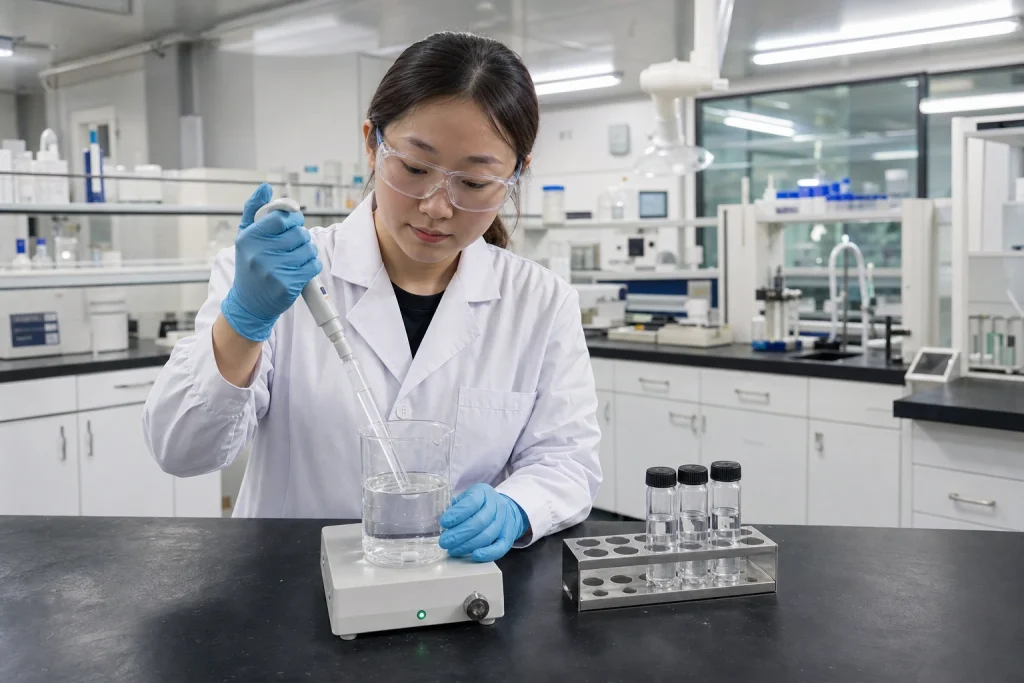
Formulation Considerations for Brightening Products
Several practical points are worth keeping in mind when working with this active:
- Use level. Concentrations in the low single digits are commonly explored in brightening serums and creams. Suppliers and formulators usually start evaluation around 1-2 percent and adjust based on stability and performance data.
- pH. A mildly acidic pH, typically in the 4 to 6 region, is commonly used. Strongly alkaline conditions should be avoided.
- Metal control. Trace iron and copper can catalyze discoloration, so a chelating agent such as EDTA or a modern alternative is a sensible inclusion, and deionized water should be used in production.
- Solubilization. The powder dissolves readily in water and glycols. Pre-dissolving in a small amount of water or propylene glycol before addition to the main batch helps avoid localized high concentrations.
- Companion actives. Ethyl ascorbic acid is frequently combined with niacinamide, alpha-arbutin, tranexamic acid and soothing agents. Pairing it with DL-Panthenol is a common approach when a brightening product also needs a moisturizing, skin-comfort story, since panthenol is easy to formulate alongside vitamin C derivatives in the same pH range.
Packaging deserves a brief mention as well. Even though the derivative is robust, opaque or amber packaging with limited headspace can be considered for premium products, simply to extend shelf appearance in aggressive climates.
Quality Parameters Buyers Should Check
When sourcing 3-O-Ethyl-L-Ascorbic Acid for cosmetic manufacturing, the certificate of analysis is the first screening tool. Points worth reviewing include:
- Assay. High-purity grades are the norm for this material; the COA should state the assay method alongside the result.
- Appearance and color. A white to off-white powder is expected. Yellowish tint in the raw material can signal oxidative degradation during manufacture or storage and tends to carry through into finished-product discoloration.
- Related substances. Residual L-ascorbic acid and process impurities should be controlled, since they affect both stability and color.
- Heavy metals and residual solvents. Standard limits apply as for any cosmetic-grade fine chemical.
- Batch consistency. Because discoloration issues often surface months after production, consistent impurity profiles across batches matter more here than for many other raw materials.
This product sits within our specialty fine chemicals range, alongside other cosmetic and pharmaceutical intermediates where tight specification control is the main purchasing criterion.
Why AXIA CHEM
AXIA CHEM supplies 3-O-Ethyl-L-Ascorbic Acid and a broad portfolio of fine chemicals to formulators, contract manufacturers and distributors across the Middle East and beyond. Our advantages are practical ones: stable factory relationships that support batch-to-batch consistency, full COA documentation with every shipment, flexible pack sizes from evaluation samples to production quantities, and a responsive technical sales team that answers specification questions quickly. We understand the logistics realities of shipping fine chemicals into Gulf ports and can advise on packaging and documentation accordingly.
If you are evaluating ethyl ascorbic acid for a brightening line or comparing suppliers on specification and lead time, contact our team for a quotation and current COA.
Regulatory disclaimer: These products are supplied for research, formulation development, industrial and non-regulated applications. Final suitability for pharmaceutical, oral care, cosmetic, food-contact or biocidal applications shall be verified by the buyer according to local regulations. AXIA CHEM does not claim that any product is FDA approved, USP/EP certified, GMP grade or approved for any specific regulated end use unless otherwise confirmed in writing with supporting documentation.