
Quaternary ammonium salts may be evaluated in construction chemicals when a formulation needs controlled interaction between water, mineral surfaces and organic ingredients. Their value depends on the individual molecule and the complete formulation. A surfactant that behaves well in a laboratory solution may behave differently in cement paste, a filled coating or an admixture concentrate. For overseas buyers, the practical starting point is a defined technical objective, followed by compatibility testing and a purchasing specification that reflects the intended use.
Where Quaternary Ammonium Salts May Fit
These compounds contain a positively charged nitrogen center paired with a counterion. Members with a sufficiently long hydrophobic chain can function as cationic surfactants. This combination may influence wetting, adsorption and dispersion behavior. However, the name of the chemical family alone does not establish performance: chain structure, counterion, concentration and the surrounding ingredients all matter.
In construction development, cationic surfactants can be considered for studies of mineral surface modification or interfacial behavior in selected coating and treatment systems. These are formulation development opportunities, rather than evidence that any particular salt is a ready-to-use concrete admixture. Buyers should define whether the desired change concerns surface wetting, particle behavior or another measurable property before comparing candidates.
It is also useful to separate cementitious applications from noncementitious products. A result obtained with a mineral filler in water does not establish suitability in fresh concrete. Likewise, improved spreading in a coating trial does not by itself demonstrate durable adhesion or water resistance after curing. Each application needs its own control formulation and acceptance criteria.
DTAC as a Candidate for Controlled Evaluation
Dodecyltrimethylammonium chloride (DTAC), CAS 112-00-5, is a defined quaternary ammonium compound with a long alkyl chain. Its cationic surfactant character makes it a possible candidate for controlled studies of surface interactions. The linked PubChem identity record helps buyers distinguish the substance from similarly named salts; it does not establish approval or performance in a construction product.
When evaluating DTAC, record the supplied form and active content before preparing samples. Equal masses of two commercial materials do not necessarily deliver equal quantities of active substance. Water or solvent carried into the formulation can also change the comparison. Express trial additions on a consistent basis and include those carrier contributions in the formulation balance.
DTAC contains chloride as its counterion. For reinforced or prestressed concrete applications, the chloride contribution must be included in the project’s technical assessment. A supplier’s chemical assay cannot substitute for checking the complete mixture against the applicable project requirements. No universal addition rate should be inferred from the chemical name or from performance in a different application.
Compatibility Comes Before Performance Claims
Construction formulations often contain several interacting additives. Cationic surfactants may associate with anionic ingredients, potentially changing solubility, appearance or functional behavior. Anionic dispersants and some polymer systems therefore deserve particular attention. The background discussion of cationic, anionic and nonionic surfactants can help purchasing and formulation teams use consistent terminology when reviewing candidate materials.
Start with small compatibility screens using the actual process water and representative raw materials. Observe precipitation, separation, viscosity changes and foam under the intended mixing conditions. Check the influence of addition order, dilution and storage. A clear mixture immediately after preparation is useful information, but it does not prove stability over the required storage period.
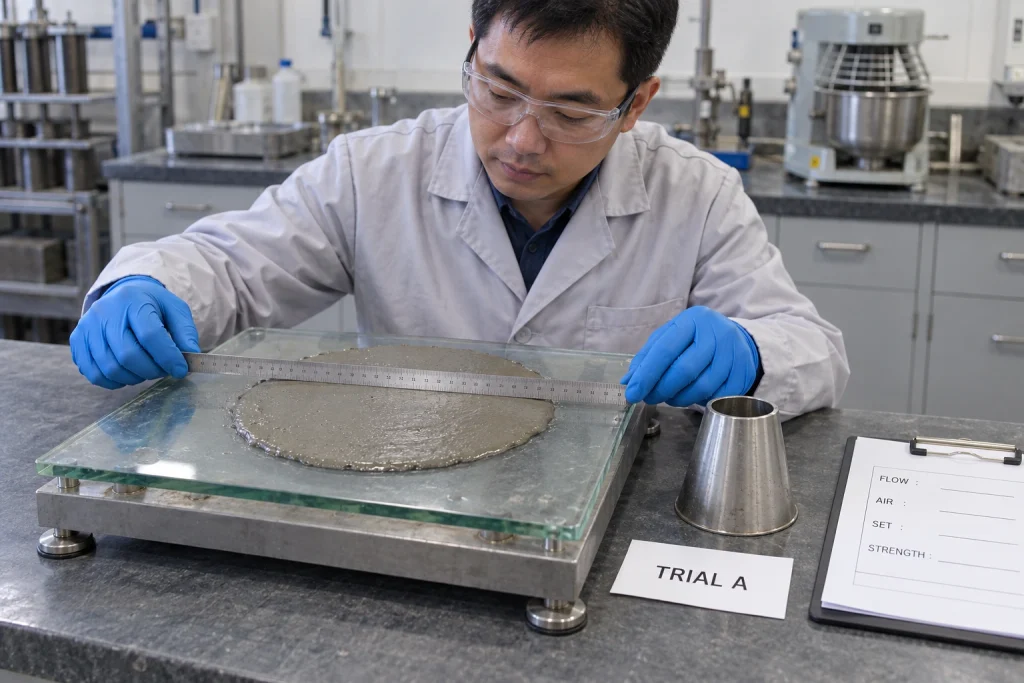
For cementitious systems, subsequent testing should examine the properties relevant to the project, such as workability retention, air content, setting behavior and strength development. An apparent improvement in one property may accompany an undesirable change elsewhere. For coatings or surface treatments, evaluate application behavior and cured-film properties together. Claims should follow measured results from the complete formulation and substrate combination.
Temperature and water composition are especially useful variables for buyers planning production or use in hot climates. Test conditions should represent the expected manufacturing, storage and application environment. Do not assume that results from a single room-temperature sample will transfer directly to a Gulf construction site.
Build a Specification That Supports Scale-Up
A purchasing specification should identify the substance, required supplied form, active-content basis and agreed test methods. Include appearance and other parameters that your development work has shown to affect consistency. Ask how the certificate of analysis reports each result and whether the sample and proposed commercial material share the same specification.
Compare offers on a consistent technical basis. Review packaging, handling requirements, storage guidance and the available safety documentation alongside price. A lower quoted price per kilogram may not represent better value if active content or the carrier system differs. Keep approved sample records so that incoming batches can be compared with the material used during qualification.
The broader formulation performance ingredients range provides a starting point for discussing candidate chemistry. Selection should still be tied to a documented trial objective. Before increasing batch size, confirm that mixing equipment and addition procedures preserve the behavior observed during development.
Why AXIA CHEM
Bring AXIA CHEM a clear application brief covering the intended formulation, target properties and purchasing requirements. Use the sourcing discussion to align candidate selection, specification details, quality documentation, packaging and delivery expectations. Request confirmation of available supply options and response timelines for your project, rather than assuming that a catalog listing establishes every commercial or technical requirement.
For a focused inquiry, include the chemical name, required supplied form, sample needs and destination market. Contact AXIA CHEM about construction formulation ingredients to discuss the information needed for evaluation and procurement.
Regulatory disclaimer: These products are supplied for research, formulation development, industrial and non-regulated applications. Final suitability for pharmaceutical, oral care, cosmetic, food-contact or biocidal applications shall be verified by the buyer according to local regulations. AXIA CHEM does not claim that any product is FDA approved, USP/EP certified, GMP grade or approved for any specific regulated end use unless otherwise confirmed in writing with supporting documentation.