
Choosing between cationic, anionic and nonionic surfactants starts with the job a formulation needs to perform. Cleaning an oily surface, wetting a powder and modifying the feel of a treated textile can require different interfacial behavior. For buyers, the charge class is a useful first filter, but it does not replace a specification or a compatibility trial. Chemical identity, active content, supplied form and the intended process conditions all influence whether a candidate deserves further evaluation.
This primer explains how the three classes differ and how to turn those differences into a practical purchasing brief. The aim is to shortlist suitable materials before comparing quotations, especially when samples and commercial shipments travel between different climates.
How charge separates the three surfactant classes
Surfactants contain regions with different affinities for water and oil. Their behavior at interfaces can support wetting, emulsification, dispersion or cleaning, depending on molecular structure and formulation conditions. Classification as cationic, anionic or nonionic refers to the electrical character of the hydrophilic portion. It does not rank overall effectiveness, purity or environmental suitability.
Cationic surfactants have a positively charged hydrophilic group. Quaternary ammonium surfactants are one familiar family. They may be evaluated where adsorption onto negatively charged surfaces is useful, including selected conditioning, surface treatment and antistatic formulations. The result depends on the substrate, competing ingredients and how the material is applied.
Anionic surfactants have a negatively charged hydrophilic group. They are commonly explored in cleaning and detergency systems, although foam, wetting and tolerance to dissolved salts differ across chemical families. Nonionic surfactants have an uncharged hydrophilic group and can be considered for wetting, emulsification and cleaning. None of these broad descriptions establishes a universal replacement ratio between products.
Where nonionic surfactants fit in a formulation shortlist
Nonionic surfactants are often considered when a developer wants to adjust wetting or emulsification without introducing another ionic head group. They may be evaluated alongside anionic or cationic ingredients, but the absence of charge does not guarantee compatibility. Solvents, electrolytes, polymers and the balance between hydrophilic and hydrophobic portions can still change clarity, viscosity and phase behavior.
For some ethoxylated nonionic materials, temperature can affect hydration and clouding. Buyers should therefore ask whether a quoted cloud point is relevant to the intended dilution, solvent composition and measurement method. A value measured in one test solution should not automatically become an acceptance criterion for a different finished formulation.
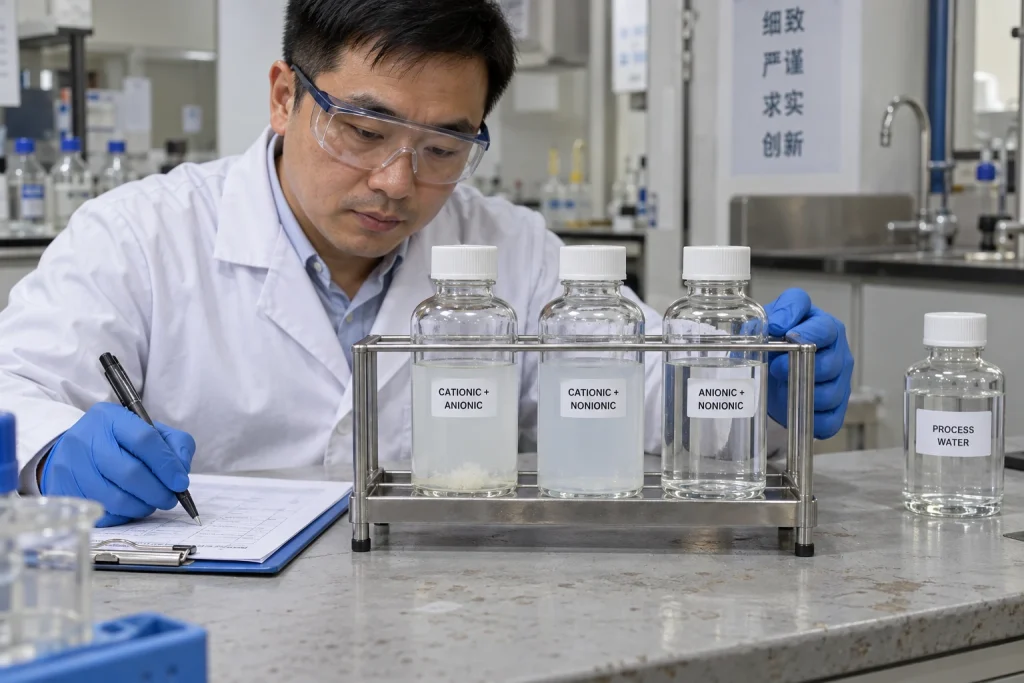
Start trials with the actual process water and realistic mixing conditions. Compare initial appearance with performance after storage and temperature cycling appropriate to the intended route and warehouse conditions. For overseas purchasing, record the supplied form and whether warming or a specified mixing procedure is needed before sampling. Obtain handling instructions from the supplier instead of applying an improvised heating step.
Using DTAC to evaluate a cationic option
Dodecyltrimethylammonium chloride, commonly abbreviated DTAC, has CAS 112-00-5. Its identity illustrates a distinction buyers should keep clear: the chloride counterion does not make the surfactant anionic. The surface-active organic ion is positively charged. Identity verification is the starting point for comparison, while a batch specification determines what material is actually offered.
Dodecyltrimethylammonium chloride may be evaluated in selected conditioning and industrial surface treatment systems. Confirm the active content, solvent or water content, appearance and relevant impurity limits for the offered grade. A quotation for a diluted product cannot be compared fairly with a more concentrated grade using price per delivered kilogram alone.
Combining a cationic surfactant with an anionic ingredient can cause ion pairing, precipitation or loss of the intended function. Some deliberately designed mixtures behave differently, so the practical purchasing rule is to request formulation evidence and test the proposed system. AXIA CHEM’s discussion of quaternary ammonium compounds in fabric softener formulations provides related context for evaluating cationic ingredients by application.
Build a specification before comparing quotations
A useful inquiry describes both the desired function and the conditions under which it must be achieved. Include the substrate or soil, process water, pH range, operating temperature, other ingredient classes and the intended addition sequence. Share measurable acceptance criteria where available, such as wetting behavior, phase stability or a defined application test, rather than asking only for a general-purpose surfactant.
- Confirm chemical identity and whether the offer is a single substance, a distribution of related components or a formulated blend.
- State the active-content basis and analytical method so that quotations and COA results can be compared meaningfully.
- Request relevant quality limits, packaging information, storage guidance and the current supplier SDS.
- Evaluate a representative sample in the complete formulation and retain the trial conditions for later batch comparisons.
Calculate cost on the agreed active-content basis, then consider handling, dilution and process requirements. A lower purchase price may offer little benefit if the supplied form adds a difficult preparation step. Conversely, a convenient solution may be appropriate when its carrier is compatible with the process. The relevant comparison is the cost of meeting the specification under actual operating conditions.
Document sample approval criteria before ordering a commercial batch. Compare the batch COA against the agreed limits and investigate meaningful changes in appearance or performance. Explore the formulation and performance ingredients category with these requirements in hand so that a product shortlist remains tied to the application.
Why AXIA CHEM
AXIA CHEM provides a sourcing contact for buyers evaluating specialty formulation ingredients. Bring the chemical identity, target specification, sample needs and intended shipment destination into the same discussion. Ask the team to confirm available supply options, batch quality documentation, packaging and expected response and delivery timelines in writing. This creates a clear basis for technical review and purchasing without assuming that every listed material is suitable for every formulation.
For a focused inquiry, contact AXIA CHEM about surfactant sourcing with your application brief and required documentation.
Regulatory disclaimer: These products are supplied for research, formulation development, industrial and non-regulated applications. Final suitability for pharmaceutical, oral care, cosmetic, food-contact or biocidal applications shall be verified by the buyer according to local regulations. AXIA CHEM does not claim that any product is FDA approved, USP/EP certified, GMP grade or approved for any specific regulated end use unless otherwise confirmed in writing with supporting documentation.