
Conditioning performance in hair care comes down to one simple idea: hair surfaces carry a net negative charge after washing, and positively charged actives are attracted to them. That is why cationic surfactants dominate the conditioning shelf. Among the short-chain members of that family, DTAC in hair conditioner formulations is best understood as a light, highly water-soluble antistatic and co-conditioning agent rather than as a primary substantive softener.
Dodecyltrimethylammonium chloride (DTAC), CAS 112-00-5, is a C12 trimethylammonium quat usually supplied as a clear aqueous solution. This guide covers what it does in a rinse-off or leave-in system, the dosage ranges formulators commonly work within, and the specification points worth fixing before you buy.
What DTAC Is and How It Differs from Longer-Chain Quats
DTAC belongs to the alkyltrimethylammonium chloride series. The head group is a permanently charged quaternary nitrogen with three methyl groups; the tail is a linear C12 (lauryl) chain. That structure makes it strongly cationic, readily water-soluble at use concentrations, and mobile in aqueous phases.
Chain length is the key variable. As the alkyl chain lengthens from C12 to C16, C18 and C22, water solubility falls, adsorption on the hair fibre becomes stronger, and the deposited layer becomes more lubricating and more resistant to rinsing. Cetrimonium and behentrimonium salts sit at the substantive end of that scale and are the usual choice where slip and detangling are the main claims. DTAC sits at the opposite end: it deposits less, rinses more cleanly, and contributes mainly charge neutralisation and reduced flyaway rather than heavy conditioning. In practice that makes it a supporting active in a conditioner and a more natural fit in shampoos, 2-in-1 systems and light rinse-out products where weighing the hair down is a real risk.
The same water solubility that limits substantivity is an advantage elsewhere. Formulators who want an antistatic effect without build-up, or who need a cationic component that stays in solution in a clear system, may find the C12 chain more workable than a C16 or C18 grade.
How DTAC in Hair Conditioner Systems Actually Works
Washing and mechanical damage expose anionic sites on the hair cuticle, and residual anionic surfactant from the shampoo step leaves the fibre negatively charged. Cationic actives adsorb onto those sites through electrostatic attraction, neutralising surface charge. The visible results are reduced static and flyaway, easier wet and dry combing, and a smoother-feeling cuticle.
DTAC contributes to the first part of that mechanism efficiently. Because the C12 tail is short, the hydrophobic layer it leaves behind is thin, so the lubricity contribution is modest compared with a fatty alcohol and cetrimonium emulsion. Most formulators therefore treat it as one element of a conditioning package: a long-chain quat or esterquat for substantive slip, a fatty alcohol for the gel network and body, a silicone or plant oil for surface smoothness, and DTAC for charge control, spreading and viscosity behaviour in the aqueous phase.
It is also worth noting that cationic actives affect foam and cleansing when a formulation contains anionic surfactant. Complexation between the two is the basis of coacervate deposition in 2-in-1 shampoos, but it is equally the reason an uncontrolled cationic addition can flatten foam and drop clarity. Those interactions are discussed further in our overview of quaternary ammonium compounds in personal care formulations.
Typical Dosage Ranges and Formulation Practice
Published formulary practice for alkyltrimethylammonium chlorides in rinse-off hair products generally falls in the low single-digit percentage range on an active basis, with lighter systems running well below one percent. Ranges commonly explored are roughly:
- Rinse-off conditioners – a fraction of a percent to about 2 percent active, used alongside a more substantive long-chain quat rather than in place of it.
- Conditioning shampoos and 2-in-1 systems – typically at the lower end, since higher cationic levels compete with the anionic cleansing surfactant.
- Leave-in sprays and detangling mists – low levels where antistatic effect and clean rinse-out feel matter more than deposition.
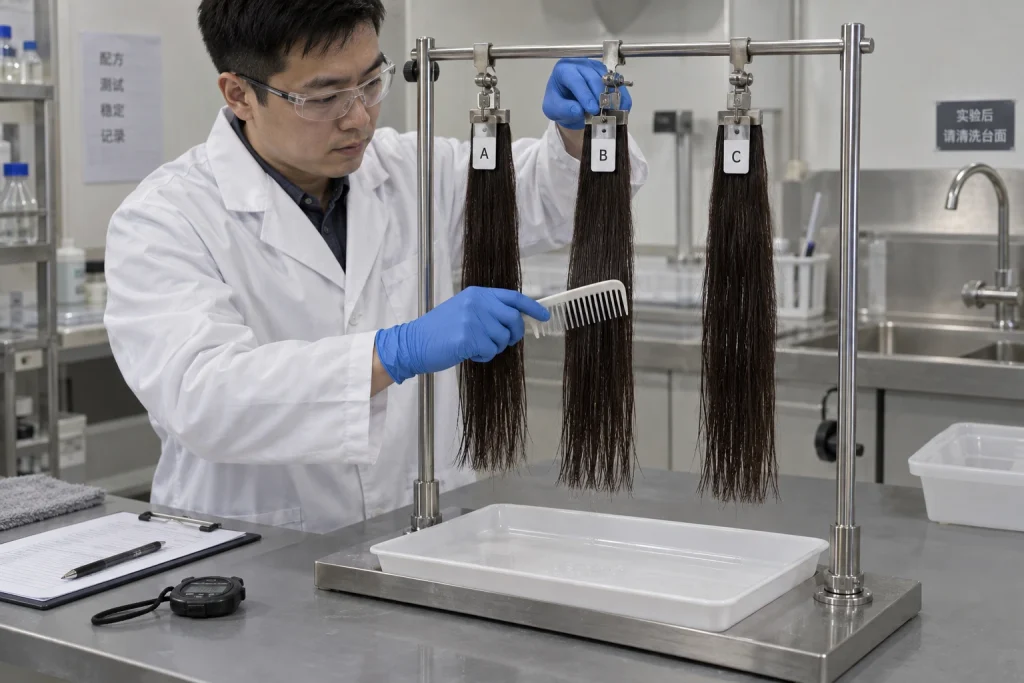
Two practical points follow. First, DTAC is usually sold as a solution, so the label concentration and the active basis must be reconciled before dosing; a 30 percent solution dosed as though it were solid will under-deliver by a factor of three. Second, these ranges are starting points for laboratory trials, not specifications. Combing force, static decay and sensory panel results on the target hair type are the only reliable confirmation, and regional water hardness and the rest of the surfactant system will shift the optimum.
Order of addition matters as well. Cationic actives are normally added to the water phase or post-emulsification at moderate temperature, with pH adjusted into the mildly acidic range that favours cuticle adsorption and product stability.
Quality Points and Supply Considerations
For personal care use the parameters that matter most on a certificate of analysis are:
- Active content – determined by two-phase titration; confirm whether the figure is as-supplied or on a dry basis.
- Free amine – an indicator of incomplete quaternisation and a common source of odour and colour drift.
- Colour (APHA) and odour – critical in clear or lightly fragranced systems, where any raw material defect is immediately visible.
- Inorganic chloride and residual alkylating agent – process residues that should be specified rather than assumed.
- pH and freeze point of the solution – relevant to storage and to shipping in colder lanes.
Solution grades should be protected from freezing and from prolonged heat, and containers kept closed to avoid concentration drift. Broader handling guidance for this product family is covered in our note on DTAC in household and industrial formulations, and the wider range of actives for this kind of system sits in our formulation and performance ingredients category.
Cosmetic buyers should also plan the documentation early: INCI name, allergen and animal-origin statements, and any market-specific registration file usually take longer to assemble than the material itself.
Why AXIA CHEM
AXIA CHEM supplies cationic surfactants and related specialty chemicals to personal care formulators, contract manufacturers and blenders across the Middle East, Africa and Asia. We work to the specification a project actually needs – active basis, colour limit, packaging format and solution strength – instead of pushing one standard grade, and we provide representative samples with batch documentation so that laboratory trials run on the same material that ships in bulk. Multiple qualified production sources, consolidated export documentation and fast technical response on specification questions keep evaluation cycles short and repeat orders predictable.
Tell us the product format, the target claim and the rest of your surfactant system, and we will propose dodecyltrimethylammonium chloride or a more substantive alternative with a COA and sample for evaluation. Contact the AXIA CHEM team for pricing, specifications and lead times.
Regulatory disclaimer: These products are supplied for research, formulation development, industrial and non-regulated applications. Final suitability for pharmaceutical, oral care, cosmetic, food-contact or biocidal applications shall be verified by the buyer according to local regulations. AXIA CHEM does not claim that any product is FDA approved, USP/EP certified, GMP grade or approved for any specific regulated end use unless otherwise confirmed in writing with supporting documentation.