
Phase transfer catalyst loading is one of the first variables a process chemist sets and one of the last to be properly optimized. Too little catalyst and a two-phase reaction may stall or run unevenly; too much and the extra cost, workup burden and residual quat in the product can outweigh any gain in rate. This note summarizes the loading ranges commonly discussed in the phase transfer catalysis literature and offers practical points that R&D and scale-up teams may consider when narrowing down a number for their own process.
The discussion focuses on quaternary ammonium catalysts such as tetrabutylammonium bromide (TBAB, CAS 1643-19-2) and benzyltriethylammonium chloride (BTEAC/TEBAC, CAS 56-37-1). The general logic also applies to other onium salts, but every reaction system should be evaluated on its own data.
What Phase Transfer Catalyst Loading Means in Practice
In phase transfer catalysis, the catalyst shuttles a reactive anion from an aqueous or solid phase into an organic phase where the substrate sits. Because the catalyst is regenerated in each cycle, only a fraction of a stoichiometric amount is normally needed. Loading is usually expressed in one of two ways:
- Mol% relative to the limiting substrate – the most common convention in laboratory work and publications.
- Weight% relative to substrate or to total charge – often preferred in plant batch records, where materials are charged by mass.
Mixing the two conventions is a frequent source of confusion during technology transfer. A catalyst with a high molecular weight, such as methyltrioctylammonium chloride, gives a very different mol% at the same weight% than a lighter salt such as BTEAC. It is good practice to record both figures in development reports so that the plant team and the supplier are working from the same basis.
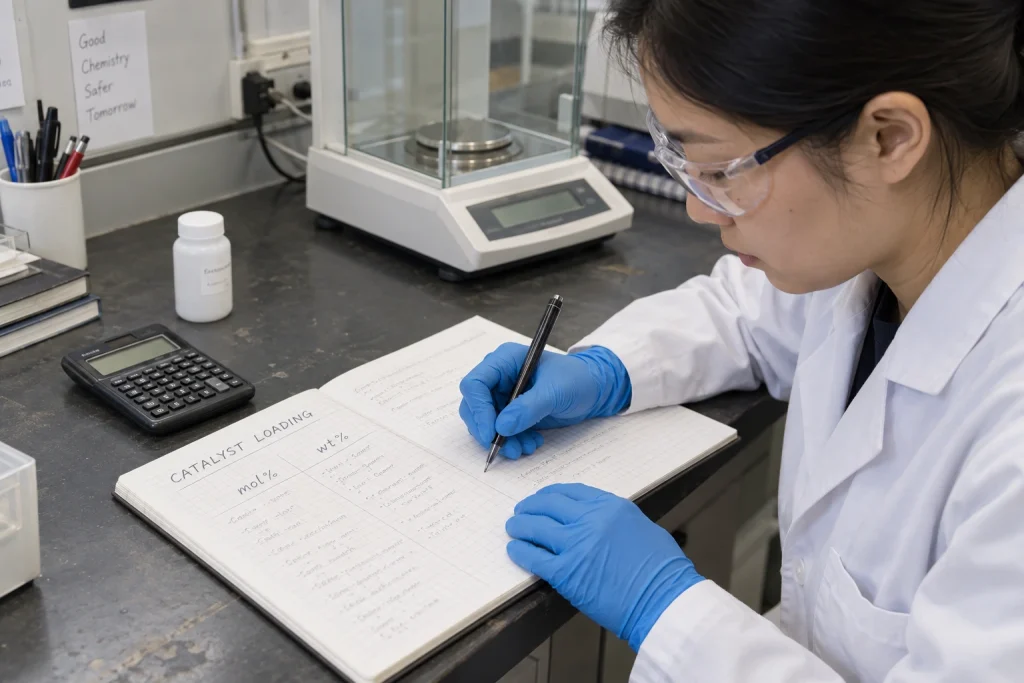
Typical Ranges Reported for Quaternary Ammonium PTCs
Across textbook and review literature on phase transfer catalysis, quaternary ammonium catalysts are most often described at loadings in the low single-digit mol% range, with roughly 1-5 mol% frequently cited as a starting point and up to around 10 mol% used for slower or more demanding systems. Lower loadings may be considered for fast, well-mixed reactions, while some solid-liquid systems and sterically hindered substrates are commonly explored at the higher end.
These figures should be treated as orientation, not as a specification. The effective loading for a given process depends on several factors:
- Reaction type. Simple nucleophilic substitutions such as alkylations and cyanations often tolerate lower loadings than reactions with poorly extractable anions.
- Anion extractability. Lipophilic anions transfer more readily into the organic phase, while hard, highly hydrated anions such as hydroxide or fluoride can require more catalyst or a more lipophilic cation.
- Catalyst structure. Symmetrical tetrabutyl salts, benzyl-substituted salts and long-chain methyltrialkyl salts partition differently between phases, so equal mol% does not mean equal activity.
- Counter-ion. The catalyst’s own anion competes with the reacting anion. Bromide, chloride and hydrogen sulfate salts can behave differently in the same reaction, which is why TBAB and TBAHS are sometimes screened side by side.
- Agitation and phase ratio. In many PTC systems the interfacial area limits the rate, and better mixing can reduce the catalyst needed.
For a broader comparison of catalyst families before loading work begins, see our guide on how to choose a phase transfer catalyst.
How to Optimize Phase Transfer Catalyst Loading
A structured screen usually gives a more defensible loading than simply copying a literature value. The following sequence is commonly used by development teams:
- Run a no-catalyst control. Some reactions proceed slowly at the interface without any catalyst. Knowing the background rate shows how much the catalyst actually contributes.
- Screen a wide bracket first. Testing, for example, a low, middle and high loading under fixed stirring, temperature and phase ratio shows whether the rate responds strongly to catalyst or has already reached a plateau.
- Track conversion over time, not only the end point. Two loadings may reach the same final conversion but at very different times, which matters for plant cycle time.
- Hold agitation constant, then vary it. If the rate improves more with better mixing than with more catalyst, the process may be mass-transfer limited and additional catalyst can be of limited value.
- Check selectivity and impurities. Higher loadings can sometimes accelerate side reactions such as hydrolysis or over-alkylation. Impurity profiles should be compared at each loading level.
- Confirm with the intended commercial grade. Catalyst assay, water content and residual amine levels can vary between grades and suppliers. A loading optimized with one material may be re-verified when switching sources.
Temperature deserves attention as well. Some quaternary ammonium salts may undergo Hofmann-type degradation under strongly basic, hot conditions, so a loading that works at moderate temperature may not hold at higher temperatures. Where catalyst decomposition is suspected, adding catalyst in portions can be evaluated as an alternative to a single larger charge.
Scale-Up, Cost and Downstream Considerations
At plant scale, the lowest loading that delivers acceptable rate and selectivity is generally the preferred target, but not always the cheapest overall. A slightly higher loading that shortens batch time or improves consistency can reduce total processing cost. Points teams commonly weigh include:
- Catalyst cost per batch versus reactor time, energy and labor.
- Removal during workup. Water-soluble catalysts such as tetrabutylammonium bromide can often be washed out into the aqueous phase, while more lipophilic quats may remain in the organic layer and need extra washes or other purification steps.
- Residual catalyst limits. For intermediates headed to regulated downstream uses, the buyer may set residual quat or halide limits that indirectly cap the usable loading.
- Waste streams. Catalyst ending up in aqueous effluent contributes to organic load and may affect wastewater treatment plans.
- Emulsion behavior. Surface-active catalysts such as benzyltriethylammonium chloride are generally less prone to heavy emulsions than long-chain quats, but loading increases can still slow phase separation in some systems.
Consistent catalyst quality supports a stable loading from batch to batch. Buyers optimizing a process may consider requesting samples from the intended commercial lot and reviewing the COA for assay, moisture and appearance before locking in the figure. Our range of catalysis and synthesis chemicals includes several common quaternary ammonium PTCs that can be evaluated side by side.
Why AXIA CHEM
AXIA CHEM supplies quaternary ammonium phase transfer catalysts and related synthesis chemicals to R&D teams, formulators and industrial buyers in the Middle East and other international markets. We support process development with lab-scale samples, batch COA documentation and consistent packaging options from small quantities to commercial volumes. Our team responds quickly to technical and commercial questions, including grade selection and specification matching for your process.
If you are evaluating phase transfer catalyst loading for a new or existing process, contact AXIA CHEM to request samples, specifications or a quotation.
Regulatory disclaimer: These products are supplied for research, formulation development, industrial and non-regulated applications. Final suitability for pharmaceutical, oral care, cosmetic, food-contact or biocidal applications shall be verified by the buyer according to local regulations. AXIA CHEM does not claim that any product is FDA approved, USP/EP certified, GMP grade or approved for any specific regulated end use unless otherwise confirmed in writing with supporting documentation.