
Phase transfer catalyst selection is one of the most practical decisions a process chemist makes when running reactions between reagents that sit in two immiscible phases. Quaternary ammonium salts such as tetrabutylammonium bromide (TBAB), benzyltriethylammonium chloride (TEBAC) and tetrabutylammonium chloride (TBAC) all move anions from an aqueous or solid phase into an organic phase, yet they behave differently in terms of solubility, thermal stability, cost and ease of removal. This guide compares the three catalysts side by side and outlines a simple framework that may be used to shortlist the right candidate for alkylations, nucleophilic substitutions, esterifications and related two-phase reactions.
How Phase Transfer Catalysts Work in Two-Phase Systems
In a typical liquid-liquid system, an inorganic nucleophile such as cyanide, hydroxide or carbonate stays in the aqueous phase while the organic substrate stays in the solvent phase, so the reaction is starved of contact between the two. A quaternary ammonium cation pairs with the anion and carries it across the interface into the organic phase, where the anion is poorly solvated and therefore highly reactive. After the reaction, the catalyst cation returns to the interface and picks up the next anion, so catalytic loadings of 1 to 10 mol percent are usually sufficient.
The same principle applies in solid-liquid systems, where a solid salt such as potassium carbonate is suspended in an organic solvent. Here the catalyst extracts anions directly from the crystal surface, and lipophilicity of the cation becomes even more important. Because the mechanism depends on the cation shuttling between phases, the structure of the quaternary ammonium salt, in particular the balance between water affinity and organic solubility, largely determines how well a given catalyst performs in a given system. A broader range of options is available on our phase transfer catalysts category page.
TBAB: The Versatile Default Choice
Tetrabutylammonium bromide (TBAB, CAS 1643-19-2) is the most widely used phase transfer catalyst and is often the first candidate screened for a new two-phase reaction. Its four butyl chains give the cation strong lipophilicity, so it partitions well into common solvents such as toluene, dichloromethane and methyl tert-butyl ether. TBAB is a free-flowing crystalline solid that is easy to charge, easy to store and available at commodity scale, which keeps procurement simple for multi-ton campaigns.
TBAB may be evaluated first for N-alkylations, O-alkylations, etherifications (Williamson type), nucleophilic substitutions with cyanide or azide, and oxidations under basic conditions. The bromide counter-ion is only weakly nucleophilic in most systems, but in reactions where bromide could compete with the intended nucleophile or contaminate a halide-sensitive product, a chloride-based catalyst can be considered instead.
TEBAC: Economic Option for Strongly Basic Media
Benzyltriethylammonium chloride (TEBAC, CAS 56-37-1) carries a benzyl group and three short ethyl chains, which makes the cation less lipophilic than TBAB but also less expensive per kilogram in many markets. TEBAC is historically associated with dichlorocarbene chemistry and other reactions run in concentrated sodium hydroxide, where it remains a workhorse. It is commonly explored for Makosza-type carbene additions, isomerizations, dehydrohalogenations and C-alkylations of active methylene compounds under 50 percent NaOH.
Two practical points are worth noting. First, benzyl-substituted quaternary salts can degrade faster than tetraalkyl analogues at elevated temperature and high alkalinity, so TEBAC suits reactions that run fast at moderate temperatures rather than prolonged operations above roughly 100 C. Second, its lower lipophilicity means it performs best when the organic phase is fairly polar or when the reaction proceeds at the interface; in very nonpolar solvents such as heptane, a more lipophilic catalyst usually wins.
TBAC: Chloride Counter-Ion and High Water Solubility
Tetrabutylammonium chloride (TBAC, CAS 1112-67-0) offers the same lipophilic tetrabutyl cation as TBAB but pairs it with chloride. This matters in two situations. When the product or downstream chemistry is sensitive to bromide impurities, for example in certain pharmaceutical intermediates or electronic chemicals, TBAC avoids introducing bromide altogether. And when the reaction itself is a chlorination or a substitution where chloride participation is acceptable, TBAC keeps the anion pool clean.
TBAC is notably hygroscopic and is frequently supplied as a concentrated aqueous solution as well as a solid, so handling and charging procedures should be defined early in process development. Its high water solubility can also simplify catalyst removal during aqueous workup, which is helpful when residual quaternary ammonium content in the isolated product must be minimized.
A Practical Selection Framework
For a first screen, the following sequence may be used. Start with TBAB for general alkylations and substitutions in moderately polar solvents; it offers the best balance of activity, availability and price for most systems. Switch the screen to TEBAC when the reaction runs in concentrated caustic, when carbene chemistry is involved, or when catalyst cost dominates the economics of a high-volume process. Move to TBAC when bromide must be excluded from the product stream or when a solution-form catalyst simplifies charging.
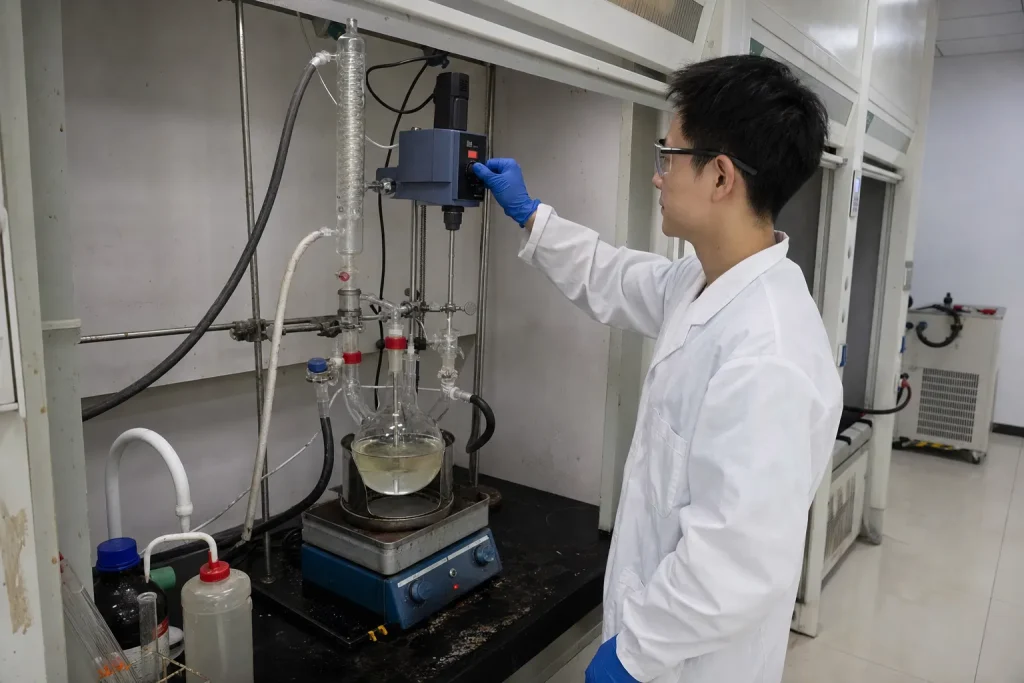
Beyond the cation and anion, three variables deserve attention in every screen: catalyst loading (screen 2, 5 and 10 mol percent), temperature (watch for Hofmann degradation of the quaternary salt under hot caustic conditions) and agitation (phase transfer reactions are often mass-transfer limited, so impeller design and mixing speed can matter as much as catalyst identity). Removal strategy should also be considered up front, since quaternary ammonium residues are typically controlled by water washes, adsorbent treatment or crystallization. Related structures such as tetrabutylammonium hydrogen sulfate or methyltrioctylammonium chloride can be considered when none of the three standard catalysts meets the target; see our full range of quaternary ammonium salts for alternatives.
Why AXIA CHEM
AXIA CHEM supplies TBAB, TEBAC, TBAC and a broad portfolio of quaternary ammonium salts and phase transfer catalysts to industrial buyers across the Middle East and worldwide. We support flexible pack sizes from development quantities to full container loads, provide batch documentation including COA on every shipment, and respond to technical and commercial inquiries quickly so your screening and scale-up timelines stay on track. If you are selecting a phase transfer catalyst for a new process or looking for a reliable second source for an existing one, contact our team for current pricing, samples and lead times.
Regulatory disclaimer: These products are supplied for research, formulation development, industrial and non-regulated applications. Final suitability for pharmaceutical, oral care, cosmetic, food-contact or biocidal applications shall be verified by the buyer according to local regulations. AXIA CHEM does not claim that any product is FDA approved, USP/EP certified, GMP grade or approved for any specific regulated end use unless otherwise confirmed in writing with supporting documentation.