
Water treatment biocide selection in the Gulf starts with the operating system, water analysis and treatment objective. Oxidizing chemicals and quaternary ammonium compounds, often called quats, act through different chemical mechanisms. Neither group offers a universal answer for cooling circuits, process water or industrial reuse. For buyers, the useful comparison is how a candidate performs under actual site conditions, how it fits existing equipment and which evidence supports its intended use.
This guide addresses industrial evaluation and raw material sourcing. A surfactant specification alone does not establish that a chemical is an effective or authorized water treatment product. Finished formulations need application-specific assessment before a procurement decision becomes an operating program.
Water Treatment Biocide Selection Starts with the System
Define the circuit before comparing quotations. An evaporative cooling tower, a closed process loop and a membrane pretreatment stage present different exposure conditions and compatibility requirements. Gulf facilities may use desalinated, blended or reclaimed makeup water, but a regional label cannot replace a current water analysis. Record the actual source, pH, conductivity, suspended solids and organic load, together with operating temperature and water turnover.
Separate routine microbial management from corrective treatment. Visible deposits, poor circulation and stagnant sections can undermine a chemical program. Cleaning, inspection and hydraulic management therefore belong in the evaluation alongside chemistry. A product trial should have a defined baseline and an agreed sampling plan, with results interpreted by personnel familiar with the system.
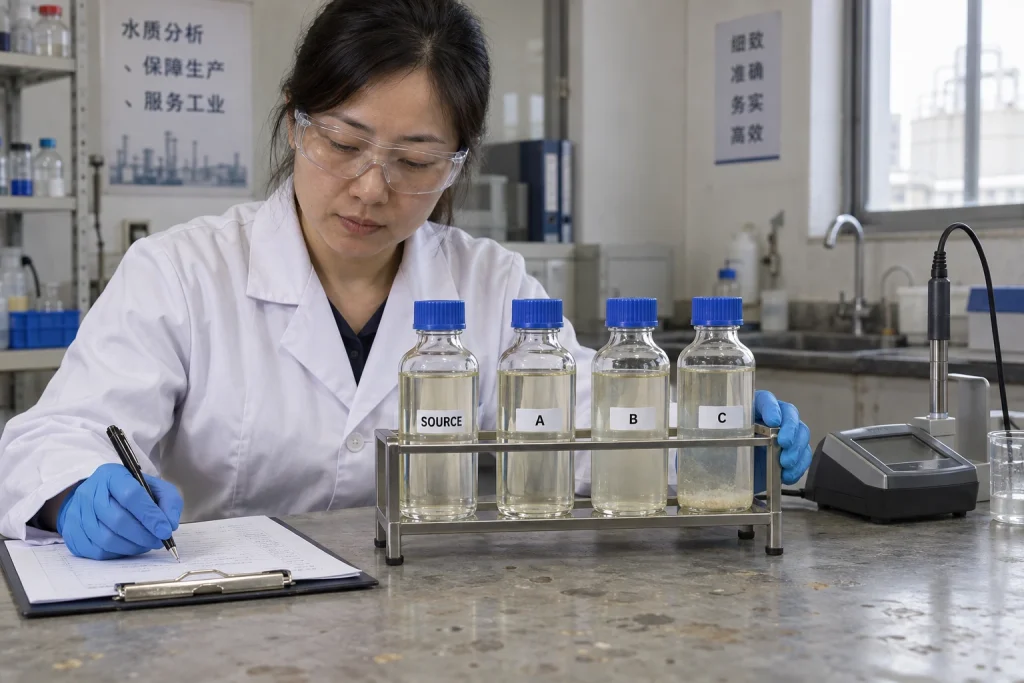
Ask the site team to identify wetted materials, downstream equipment and discharge destinations. Buyers should also distinguish bulk-water measurements from evidence about attached growth. A satisfactory result in a bottle does not by itself demonstrate performance across an operating plant.
Oxidizing Systems: Residual Control and Compatibility
Oxidizing treatments act by chemically attacking susceptible cellular components. Their practical performance depends on the available active species, the water chemistry and the demand exerted by substances in the circuit. A nominal feed setting is therefore different from a measured residual at a representative sampling point.
For cooling towers, CDC cooling tower guidance distinguishes residual monitoring for oxidizing disinfectants from product-label concentration and contact-time requirements for non-oxidizing disinfectants. It also places water turnover and system maintenance within the control program. These principles support a monitored operating plan, rather than selection by chemical price alone.
Oxidizing chemistry may be evaluated where the facility can maintain suitable feed control and monitor the relevant residual. Selection still requires review of corrosion, elastomers, coatings and downstream process sensitivity. Membranes and other sensitive components need explicit compatibility checks against equipment supplier requirements. An oxidation-reduction potential reading may provide useful process information, but it should not automatically be treated as a direct measurement of a particular disinfectant concentration.
Commercial comparisons should include chemical demand, analytical support and handling arrangements. Avoid transferring a treatment schedule from another plant without checking whether its water composition and equipment are comparable.
Quat Systems: Molecular Identity and Formulation Matter
Quats are a broad family of positively charged compounds. Some are evaluated for antimicrobial formulations because their interaction with cell envelopes can disrupt membrane function. Alkyl-chain structure, formulation composition and test conditions matter; membership in the quat family does not establish equivalent performance across products.
For example, dodecyltrimethylammonium chloride (DTAC), CAS 112-00-5, is a defined cationic surfactant that may be evaluated in formulation development. Its identity and supplied concentration should be established before comparing samples. This example does not establish DTAC as a substitute for a validated commercial cooling-water biocide.
Cationic ingredients can interact with anionic formulation components and negatively charged surfaces. Such interactions may change compatibility or reduce the freely available ingredient. Surfactant behavior also makes foaming relevant, particularly in aerated circuits. Evaluate these effects in representative water containing the treatment additives already used on site.
The wider formulation and performance ingredients category provides a sourcing context for these materials. For related development considerations, see our discussion of cationic surfactants in industrial water treatment. Selection should remain specific to the molecule, formulation and intended circuit.
Build a Buyer Evaluation Plan Before Comparing Cost
Start with a written specification covering chemical identity, active content, relevant impurities, physical form and test methods. Compare offered concentrations on the same basis. A lower price per kilogram of solution may not represent a lower cost per kilogram of active ingredient, and neither figure establishes the cost of achieving the treatment objective.
Request a representative certificate of analysis, the applicable safety data sheet and clear packaging information. Confirm storage conditions and the supplier’s stated shelf life for the offered grade. For Gulf deliveries, discuss transport exposure and receiving arrangements using the actual product documentation rather than assuming that every aqueous solution tolerates the same conditions.
A controlled evaluation can examine dilution behavior, compatibility, foaming and relevant microbial endpoints. Define acceptance criteria before testing and account for chemical carryover during microbiological sampling through a validated laboratory method. Record corrosion or material changes where relevant. A specialist should determine whether results justify moving from laboratory work to a supervised site trial.
Oxidizing and non-oxidizing products may be considered within a coordinated program, but this does not imply that concentrates can be mixed. Any combined use needs a documented compatibility and operating review. Confirm applicable product authorizations and discharge requirements for the destination and application before implementation.
Why AXIA CHEM
Use discussions with AXIA CHEM to align the requested chemical identity, grade, documentation and supply quantity before placing an order. A clear specification helps organize quality review, sample evaluation and commercial follow-up. Ask for confirmation of available batch documentation, packaging options and lead time for the specific material under consideration.
For a focused response, share the intended industrial development application, required concentration, annual demand and destination port. Contact AXIA CHEM about your raw material requirements to discuss sourcing and the information needed for buyer qualification.
Regulatory disclaimer: These products are supplied for research, formulation development, industrial and non-regulated applications. Final suitability for pharmaceutical, oral care, cosmetic, food-contact or biocidal applications shall be verified by the buyer according to local regulations. AXIA CHEM does not claim that any product is FDA approved, USP/EP certified, GMP grade or approved for any specific regulated end use unless otherwise confirmed in writing with supporting documentation.