
Sourcing methoxypropyl piperidin-4-amine for a synthesis program requires more than matching a CAS number to a quotation. 1-(3-Methoxypropyl)piperidin-4-amine (CAS 179474-79-4) is a functionalized piperidine building block that appears in pharmaceutical intermediate supply chains, and buyers who evaluate it carefully at the specification stage tend to avoid costly surprises at scale-up. This guide walks through what the molecule is, where it is typically used, which quality parameters matter on a certificate of analysis, and how to structure a supplier evaluation before committing to commercial volumes.
What Is 1-(3-Methoxypropyl)piperidin-4-amine?
1-(3-Methoxypropyl)piperidin-4-amine (CAS 179474-79-4) is a disubstituted piperidine carrying two distinct nitrogen functionalities: a tertiary ring nitrogen alkylated with a 3-methoxypropyl chain, and a primary amine at the 4-position of the ring. The molecular formula is C9H20N2O with a molecular weight of approximately 172.3 g/mol. The material is typically supplied as a liquid.
The combination of a nucleophilic primary amine and a protected-ether side chain makes this compound a versatile coupling partner. The primary amine can be acylated, sulfonylated, or engaged in reductive amination, while the methoxypropyl group contributes polarity and conformational flexibility to the final molecule without introducing additional reactive handles. In practice, the compound is most often discussed as an advanced pharmaceutical intermediate, and it is commonly associated in the literature with the synthesis of benzofuran carboxamide-type prokinetic agents. As with any intermediate, the intended downstream use should drive the specification you request, and final suitability for any regulated application must be verified by the buyer.
Typical Applications and Reaction Roles
Buyers generally evaluate 1-(3-methoxypropyl)piperidin-4-amine in one of three contexts:
Amide coupling substrate. The primary amine at the 4-position reacts readily with activated carboxylic acids, acid chlorides, and coupling-reagent-activated esters. This is the most common role in route designs, where the piperidine fragment is joined to an aromatic acid core late in the synthesis.
Reductive amination partner. The primary amine may be evaluated in reductive amination with aldehydes and ketones where a secondary amine linkage is required in the target structure.
Building block for medicinal chemistry libraries. Research groups exploring piperidine-based scaffolds can consider this compound as a starting point because the two nitrogen atoms are already differentiated, which reduces the need for protecting-group manipulation.
Because the compound sits close to the final API step in several published routes, impurity carry-over is a real concern. Related substances that survive the final coupling can end up specified in the drug substance, which is why intermediate quality deserves the same scrutiny as the API itself.
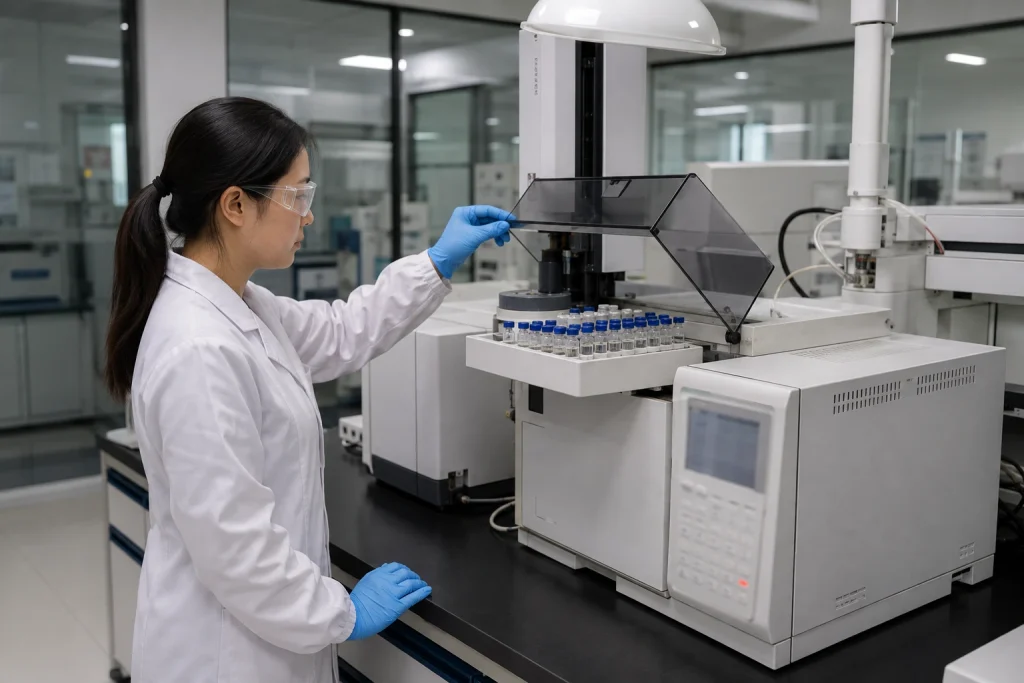
Quality Parameters to Specify on the COA
When you request a certificate of analysis, the following parameters are worth defining explicitly rather than accepting a generic template:
Assay and identity. A GC or HPLC assay, typically specified at 98 percent minimum or higher for pharmaceutical work, together with identity confirmation by NMR or IR. Ask which method the assay uses, since GC area percent and titration can give different numbers for amine-rich molecules.
Individual and total impurities. For late-stage intermediates, individual unknown impurities are often capped at 0.10 to 0.50 percent depending on the stage of the program. Ask the supplier to disclose known process impurities, such as residual starting materials from the alkylation step or over-alkylated byproducts, so your analytical team can build a meaningful related-substances method.
Water content. Primary amines are frequently hygroscopic, and water interferes with acylation chemistry. A Karl Fischer limit should be agreed in advance.
Color and appearance. Amine intermediates can discolor on storage through oxidation. A defined color specification helps you reject degraded lots at goods-in rather than discovering the problem in the reactor.
Residual solvents. Ask which solvents are used in the final isolation and request limits consistent with your downstream purge expectations.
Handling, Packaging, and Storage Considerations
As an aliphatic amine, 1-(3-methoxypropyl)piperidin-4-amine should be treated as corrosive to skin and eyes, and it can absorb carbon dioxide and moisture from air. Practical points buyers commonly raise with suppliers include inert-gas blanketing of packaging, the choice of container lining for liquid material, and whether the supplier ships under nitrogen in fluorinated drums or stainless containers for larger volumes. Cool, dry, ventilated storage away from acids and oxidizers is the general recommendation; confirm specific storage guidance against the supplier SDS for the lot you receive.
For international shipments, confirm the transport classification with the supplier in advance, since amine products may be regulated as corrosive substances for sea and air freight. Lead time planning should account for hazardous-goods documentation and carrier acceptance, particularly for LCL sea shipments into Gulf ports.
How to Evaluate a Supplier Before Scaling Up
A structured evaluation usually runs in three stages. First, review documentation: specification sheet, representative COA, SDS, and, where relevant, an impurity profile discussion. Second, test a sample lot of 25 to 100 grams in your actual chemistry, not just against the COA, because performance in your coupling step is the real acceptance criterion. Third, before commercial commitment, discuss batch size, campaign scheduling, and change-control notification so that a process change on the supplier side does not silently shift the impurity profile you validated.
This compound belongs to the broader family of nitrogen-containing fine chemicals where route know-how and analytical transparency separate reliable suppliers from traders. Buyers sourcing related piperidine and amine intermediates can browse our specialty fine chemicals range, and the dedicated page for 1-(3-methoxypropyl)piperidin-4-amine carries current specification and packaging details. Teams whose programs also involve quaternary ammonium chemistry may find our quaternary ammonium salts line a useful complement for phase transfer and surfactant needs.
Why AXIA CHEM
AXIA CHEM supplies fine chemical intermediates from audited production sources in China with a focus on consistent, well-documented quality. Our team provides full pre-shipment documentation including COA and SDS, supports sample-first evaluation so your chemists can qualify material before scale commitment, and responds to technical and commercial inquiries quickly across time zones. We handle export packaging and hazardous-goods logistics for buyers in the Middle East and worldwide, and we communicate proactively on lead times and lot traceability. To request a quotation or a sample of 1-(3-methoxypropyl)piperidin-4-amine, contact our team and we will respond within one business day.
Regulatory disclaimer: These products are supplied for research, formulation development, industrial and non-regulated applications. Final suitability for pharmaceutical, oral care, cosmetic, food-contact or biocidal applications shall be verified by the buyer according to local regulations. AXIA CHEM does not claim that any product is FDA approved, USP/EP certified, GMP grade or approved for any specific regulated end use unless otherwise confirmed in writing with supporting documentation.