
Chiral benzylic alcohols are among the most quality-sensitive intermediates in modern pharmaceutical synthesis, and (S)-1-(2,6-dichloro-3-fluorophenyl)ethanol is a good example of why. This dichloro-fluorophenyl ethanol building block carries a single stereocenter that is set early in a synthetic route and then carried through several downstream steps, so any weakness in enantiomeric purity, chemical purity or moisture control shows up later as yield loss, difficult purifications or off-specification API. This article summarizes the quality points that procurement and R&D teams typically review when qualifying this intermediate from a new supplier.
What (S)-1-(2,6-Dichloro-3-fluorophenyl)ethanol Is Used For
(S)-1-(2,6-Dichloro-3-fluorophenyl)ethanol (CAS 877397-65-4) is a halogenated aromatic secondary alcohol with an (S)-configured carbinol carbon. It is widely known as a key chiral intermediate for crizotinib (CAS 877399-52-5), an ALK/ROS1 kinase inhibitor, where the alcohol is converted through a Mitsunobu-type or activation-substitution sequence into the aryl ether linkage of the final molecule. Because that step proceeds with inversion of configuration, the stereochemistry of the alcohol directly determines the stereochemistry of the drug substance.
Beyond this well-known route, the same scaffold may be evaluated in other kinase inhibitor programs and in medicinal chemistry work where a 2,6-dichloro-3-fluorophenyl motif is desired. The combination of two ortho chlorines and a meta fluorine gives a sterically crowded, electron-poor ring that can be considered attractive for tuning binding and metabolic stability. For a wider view of the halogenated intermediates in this space, see our specialty fine chemicals range.
Enantiomeric Purity Is the First Quality Gate
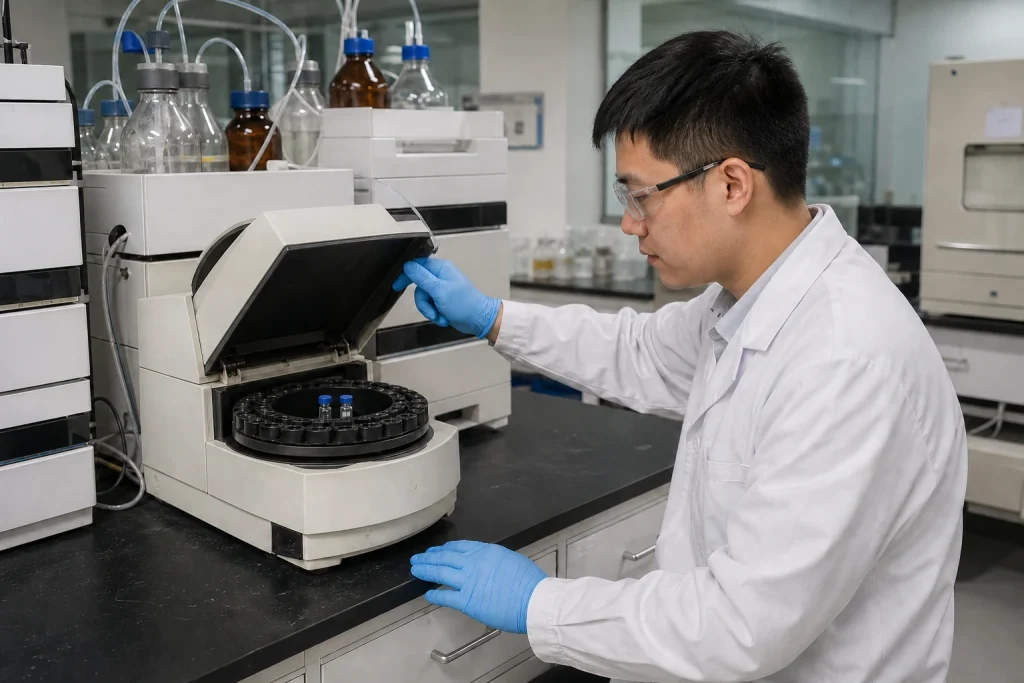
The single most important specification for this material is enantiomeric excess (ee). Typical commercial grades target 98 to 99 percent ee or higher; for late-stage pharmaceutical use, buyers commonly ask for 99 percent ee or better and require the certificate of analysis to state the analytical method used.
Points worth checking when reviewing a supplier’s data:
- Method: chiral HPLC on a polysaccharide-based column is the usual approach. The COA should name the column type and mobile phase, not just report a number.
- Which enantiomer: the sheet should confirm the (S)-isomer explicitly, ideally with an optical rotation value and sign in a stated solvent and concentration. Racemic 1-(2,6-dichloro-3-fluorophenyl)ethanol is also sold, and a mislabelled racemate is a costly mistake.
- Route awareness: the (S)-alcohol is typically produced either by asymmetric reduction of 2,6-dichloro-3-fluoroacetophenone (chemical or biocatalytic) or by kinetic resolution of the racemate. Each route has a characteristic impurity profile, so it is reasonable to ask which approach the supplier uses.
Enantiomeric purity is not something that can be corrected easily downstream, so this is the point where most qualification effort should be spent.
Chemical Purity and Related Substances
Alongside ee, chemical purity by HPLC (area percent) is normally specified at 98 to 99 percent minimum. The impurities that are most often discussed for this intermediate include:
- Residual ketone: unreacted 2,6-dichloro-3-fluoroacetophenone from incomplete reduction. It is generally easy to detect by HPLC and can carry through into downstream steps if not controlled.
- Regioisomeric or dehalogenated by-products: minor species arising from upstream Friedel-Crafts or halogenation chemistry, or from over-reduction. Their levels are usually low but should be reported as individual and total unknown impurities.
- Residual solvents: depending on the process, alcohols, esters, toluene or heptane may be present. GC data against a stated limit is expected for pharmaceutical use.
- Water content: the compound is a relatively low-melting solid or viscous liquid depending on purity and temperature, and moisture is often specified by Karl Fischer, commonly below 0.5 percent, because water can interfere with the subsequent activation step.
Buyers frequently request a full HPLC chromatogram and an H-1 NMR spectrum with the COA, so that the impurity picture can be reviewed rather than only a summary number.
Handling, Packaging and Stability Considerations
(S)-1-(2,6-Dichloro-3-fluorophenyl)ethanol is a halogenated aromatic alcohol and should be handled with the usual precautions for such compounds: gloves, eye protection and good ventilation. From a stability standpoint the material is generally robust when kept cool, dry and protected from light, but a few practical points apply:
- Store in tightly sealed containers under an inert atmosphere where possible; long-term storage at reduced temperature is commonly recommended.
- Avoid strong oxidizers, which can convert the alcohol back to the ketone and thereby erode both chemical purity and ee.
- Packaging for export is typically in fluorinated HDPE or glass containers of 1 kg to 25 kg, with drums for larger volumes. Confirm that packaging materials are compatible and that tamper-evident seals are used.
- Ask for retest data or an accelerated stability summary if the material will be held for an extended period before use.
Batch-to-batch consistency is often more important than headline purity for this class of intermediate, so it is reasonable to request COAs from several recent lots during qualification.
Practical Sourcing Checklist
When comparing suppliers of this dichloro-fluorophenyl ethanol intermediate, procurement teams may find the following checklist useful:
- Confirm the specific enantiomer, CAS number and structure on the quotation and COA.
- Require ee by chiral HPLC with method details, plus optical rotation.
- Require chemical purity by HPLC with individual and total impurity limits.
- Check water content, residual solvents and appearance against your internal specification.
- Ask about the synthetic route and change-control practice, so that a future process change does not silently alter the impurity profile.
- Request a sample for in-house evaluation before committing to commercial quantities.
Our page for (S)-1-(2,6-dichloro-3-fluorophenyl)ethanol provides the current specification and packaging options.
Why AXIA CHEM
AXIA CHEM supplies (S)-1-(2,6-dichloro-3-fluorophenyl)ethanol and related halogenated and chiral intermediates to pharmaceutical, contract manufacturing and research customers in the Middle East, Europe, Asia and beyond. Every lot ships with a batch-specific COA, and supporting analytical data such as chiral HPLC traces and NMR spectra can be provided on request. Our team responds quickly to technical questions, offers samples for evaluation, and can scale from kilogram quantities to bulk supply with consistent documentation. To discuss specifications, lead times or a sample request, please contact AXIA CHEM.
Regulatory disclaimer: These products are supplied for research, formulation development, industrial and non-regulated applications. Final suitability for pharmaceutical, oral care, cosmetic, food-contact or biocidal applications shall be verified by the buyer according to local regulations. AXIA CHEM does not claim that any product is FDA approved, USP/EP certified, GMP grade or approved for any specific regulated end use unless otherwise confirmed in writing with supporting documentation.