
Building a compliant, stable and cost-effective CPC disinfectant formulation is a recurring challenge for hygiene product manufacturers across the GCC, where high ambient temperatures, hard water and a demanding regulatory import environment all put pressure on cationic chemistry. Cetylpyridinium chloride sits alongside a wider family of quaternary ammonium compounds that formulators use in surface disinfectants, hand hygiene products, laundry sanitizers and institutional cleaning concentrates. This article looks at how CPC compares with other cationic quats, what formulators typically watch during development, and which raw material quality parameters matter most when sourcing for the Middle East hygiene sector.
Why Cationic Quats Dominate Hygiene Formulations
Quaternary ammonium compounds carry a permanent positive charge on the nitrogen atom, which allows them to associate with the negatively charged surfaces of many microbial cell membranes. That basic property is the reason quats have been used for decades in disinfectant and sanitizer chemistry. They are generally low odor compared with phenolics, they are not oxidizing like hypochlorite, and they leave a residual cationic film on treated surfaces that many institutional customers value.
The practical family used in hygiene work is fairly narrow. Benzalkonium chloride (CAS 8001-54-5) remains the volume workhorse in surface disinfectants. Cetylpyridinium chloride monohydrate (CAS 6004-24-6) is a pyridinium quat that is widely explored in oral care and in personal hygiene formats where a well characterized single-chain cationic is preferred. Alkyltrimethylammonium salts such as dodecyltrimethylammonium chloride (CAS 112-00-5) and hexadecyltrimethylammonium bromide (CAS 57-09-0) are more often used for their surfactant and conditioning behaviour, sometimes in combination with a primary biocidal quat rather than as the biocide itself.
Selection is rarely about a single performance number. Formulators weigh solubility in the intended water quality, foam profile, compatibility with the rest of the system, cost per active kilogram, and whether the material can be registered in the destination market. AXIA CHEM supplies a range of quaternary ammonium salts used in hygiene chemistry to support that evaluation stage.
Formulation Considerations Specific to CPC
CPC is supplied commercially as the monohydrate and, less commonly, in anhydrous form. The hydration state affects the assay basis, so the first practical step in any CPC disinfectant formulation is to confirm whether the specification and the dosing calculation are on the same footing. A monohydrate assay reported on an as-is basis will not match an anhydrous calculation, and that difference is large enough to matter in a finished product where actives are declared.
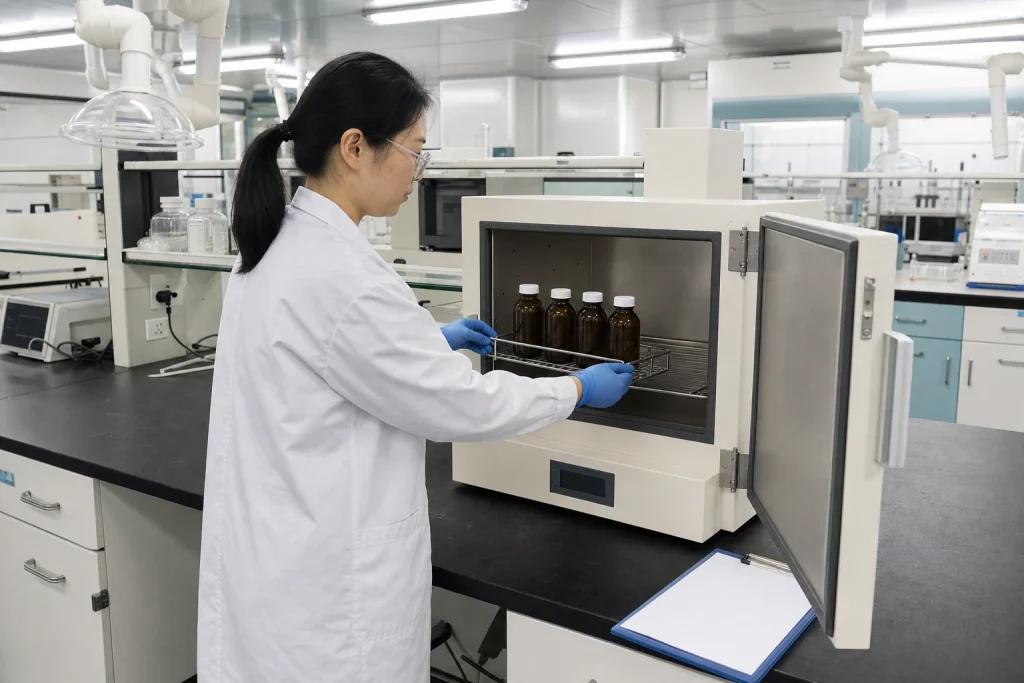
Solubility behaviour is the second consideration. CPC dissolves readily in water and in lower alcohols, but concentrated solutions can show clouding or crystallization when stored cold, and formulators often introduce a co-solvent or a hydrotrope to keep concentrates clear across the storage range. In GCC warehousing conditions the reverse problem is more common: sustained high temperature storage, which is why accelerated stability work at elevated temperature is worth running early rather than at the end of development.
Anionic incompatibility is the classic pitfall. Like other cationics, CPC will complex with anionic surfactants such as linear alkylbenzene sulfonate or sodium lauryl sulfate, and the resulting complex can precipitate and strip activity from the system. Practical formulations therefore pair cationic actives with nonionic or amphoteric surfactants. Hard water is a related issue across much of the region, since calcium and magnesium ions and residual anionic soil can both reduce the available cationic active on the surface being treated. Chelation and a realistic hard water test protocol can be considered part of standard development work rather than an optional extra.
Blending CPC with Other Cationic Actives
Many commercial systems do not rely on one quat. A common approach is to combine a primary quat with a secondary cationic or a nonionic surfactant that improves wetting, soil removal and substantivity. Alkyltrimethylammonium chlorides such as dodecyltrimethylammonium chloride may be evaluated in this supporting role, where the shorter C12 chain contributes solubility and foam behaviour that a longer chain cationic does not provide on its own.
Where blends are used, three checks are worth building into the development plan. First, confirm that the combined cationic charge density does not create a residue problem on the intended substrate. Second, verify that the pH window suits all components, since quats are generally stable across a broad pH range but co-formulants often are not. Third, document actual performance against the target organisms with the finished formulation rather than extrapolating from raw material literature, because the matrix effect in a real product can be substantial.
Raw Material Quality Parameters That Matter
For a hygiene formulator, the value of a quat supply relationship shows up in the certificate of analysis. The parameters that typically drive downstream behaviour include assay, water content, free amine or residual tertiary amine, residual solvents, pH of a standard aqueous solution, colour, and heavy metals. Free amine is worth particular attention because it can contribute odour and, in some systems, colour drift over shelf life. Water content matters for both dosing accuracy and for materials that are prone to caking.
Consistency across batches is often more valuable than a marginally tighter single specification. A formulation that has been validated against one batch profile can behave differently when assay or impurity levels shift, and re-validation is expensive. Buyers sourcing cetylpyridinium chloride monohydrate for hygiene applications generally ask for a recent representative COA, a retained sample policy, and clarity on whether the analytical method behind each parameter has changed between batches.
Regulatory positioning is the final piece. Biocidal claims are controlled in most GCC markets, and the registration pathway for a finished disinfectant is separate from the supply of the raw material. Formulators are responsible for confirming that both the active and the finished product meet the requirements of the destination market before any efficacy claim is made.
Why AXIA CHEM
AXIA CHEM supplies cationic quats and related fine chemicals to formulators and distributors serving the Middle East and wider export markets. Our focus is on reliable batch-to-batch consistency, transparent documentation, and responsive technical support during the sampling and scale-up phases. We work with manufacturing partners across multiple product families, which means we can support both single-product supply and broader sourcing programmes across specialty fine chemicals. Sample quantities, full COA packages and lead time confirmation are available on request.
If you are developing or reformulating a disinfectant system and need a dependable quat supply, contact the AXIA CHEM team to discuss specifications, sample availability and delivery to your port.
Regulatory disclaimer: These products are supplied for research, formulation development, industrial and non-regulated applications. Final suitability for pharmaceutical, oral care, cosmetic, food-contact or biocidal applications shall be verified by the buyer according to local regulations. AXIA CHEM does not claim that any product is FDA approved, USP/EP certified, GMP grade or approved for any specific regulated end use unless otherwise confirmed in writing with supporting documentation.