
Aliquat 336 solvent extraction is one of the most widely studied approaches to separating and recovering metals from aqueous leach solutions. The reagent, a quaternary ammonium salt based on methyltrioctylammonium chloride, acts as a liquid anion exchanger: it pulls anionic metal complexes out of an aqueous phase and into an organic phase, from which the metal can later be stripped and recovered. For hydrometallurgical operations, battery recycling projects and research groups working on metal separation, understanding how this reagent behaves is the first step toward deciding whether it fits a given flowsheet. This article explains the chemistry behind the extraction mechanism, the metal systems where the reagent is commonly explored, and the practical points B2B buyers should keep in mind when sourcing it.
What Is Aliquat 336?
Aliquat 336 is a commercial designation for a quaternary ammonium chloride in which one methyl group and three long alkyl chains are attached to a central nitrogen atom. The principal component is methyltrioctylammonium chloride (CAS 5137-55-3), typically supplied as a mixture in which the long chains are predominantly C8 with a portion of C10. The material is a viscous liquid that is essentially insoluble in water but readily soluble in common organic diluents such as kerosene and aliphatic hydrocarbons.
Because the nitrogen carries a permanent positive charge, the molecule remains cationic across the entire pH range. This distinguishes it from amine extractants, which must first be protonated in acidic solution before they can extract anions. The permanent charge is what allows the reagent to be considered for extractions from neutral and even mildly alkaline media, where conventional amines lose their capacity. Like other members of the quaternary ammonium salts family, it also shows surface activity and phase transfer behavior, which is why the same compound appears in catalysis literature as well as in hydrometallurgy.
How the Anion Exchange Mechanism Works
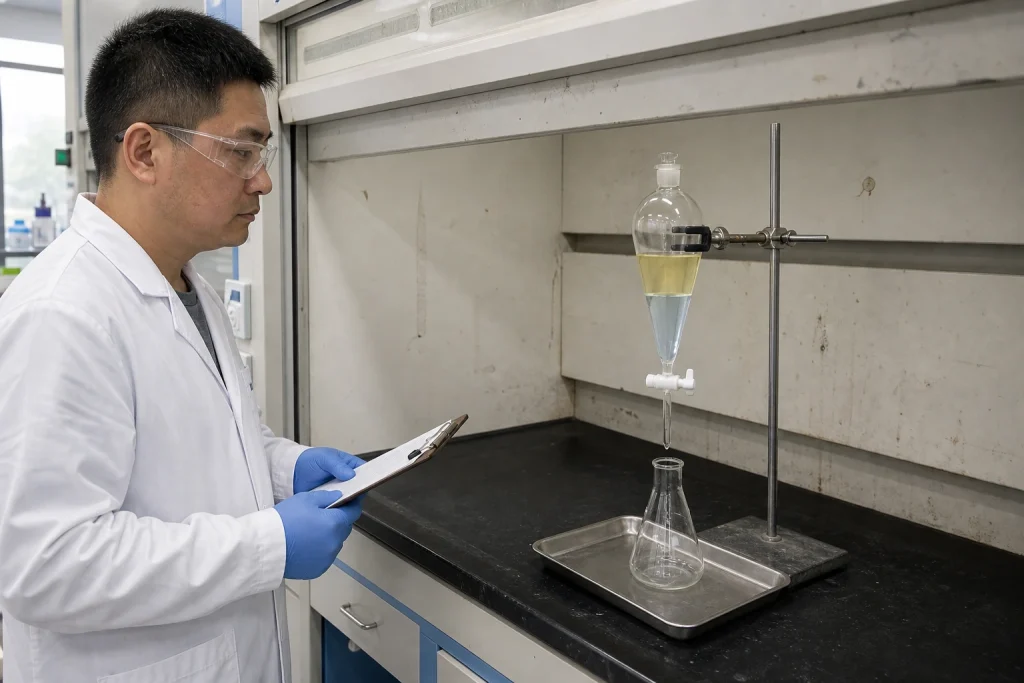
In solvent extraction service, the reagent operates as a liquid anion exchanger. The chloride counter-ion associated with the quaternary nitrogen can be exchanged for another anion present in the aqueous phase. When a metal forms an anionic complex in solution – for example a chloro-complex in concentrated chloride media – that complex can displace the chloride on the extractant and transfer into the organic phase as an ion pair.
A simplified sequence looks like this: the metal is leached into an aqueous solution and converted into an anionic complex by adjusting the ligand concentration; the loaded aqueous phase is contacted with the organic phase containing the extractant dissolved in a diluent; the anionic metal complex exchanges with chloride and moves into the organic phase; after phase separation, the loaded organic is contacted with a strip solution that reverses the exchange and returns the metal to a clean aqueous phase. Selectivity comes from the fact that different metals form anionic complexes under different conditions, so the chemistry of the aqueous phase – chloride concentration, acidity, oxidation state – can be tuned to extract one metal while leaving another behind.
Metal Systems Where Aliquat 336 Is Commonly Explored
The extraction literature covers a broad range of metal systems, and the reagent may be evaluated wherever a target metal forms a stable anionic complex. Frequently studied examples include:
- Cobalt and nickel separation. In concentrated chloride media, cobalt forms anionic chloro-complexes while nickel largely does not. This difference is commonly explored as a basis for separating the two metals, a separation of clear interest to battery materials and recycling projects.
- Zinc, cadmium and iron. These metals form extractable chloro-complexes and are often studied in the context of purifying process liquors and treating chloride leach solutions.
- Rare earth elements. The reagent can be considered for rare earth separations from nitrate or thiocyanate media, where selectivity patterns differ from those of acidic extractants.
- Precious metals. Anionic complexes of gold and platinum group metals are commonly explored targets in refining and recycling studies.
- Oxo-anions. Species such as chromate, molybdate, vanadate and rhenium as perrhenate may be evaluated for removal or recovery from effluents and leach liquors.
Beyond classical solvent extraction, the same chemistry appears in ionic liquid research, supported liquid membranes and deep eutectic solvent studies, where methyltrioctylammonium chloride serves as a hydrophobic cation source.
Practical Process Considerations
Buyers moving from laboratory screening toward larger scale work usually pay attention to a few recurring practical points. The neat reagent is viscous, so it is normally diluted to a working concentration in a hydrocarbon diluent; a long chain alcohol modifier is often added, since quaternary ammonium extractants are known to be prone to third phase formation in its absence. Phase disengagement behavior should be checked under realistic loading, because slow separation or stable emulsions can limit throughput. Stripping strategy also deserves early attention: because the extractant works by anion exchange, stripping generally relies on shifting the aqueous chemistry so the metal complex is no longer favored, and the ease of stripping varies from system to system. Finally, extraction performance is sensitive to the composition of the feed, so results obtained on synthetic solutions should be confirmed on real process liquors before any scale-up decision.
It is also worth remembering that the reagent belongs to the same family as industrial phase transfer catalysts. Facilities that already handle quaternary ammonium salts for synthesis will find the storage and handling profile familiar: the product is supplied in drums, protected from strong oxidizers, and handled with standard precautions for concentrated surfactant-like liquids.
Sourcing and Quality Considerations for B2B Buyers
Because Aliquat 336 type products are supplied as technical mixtures rather than single pure compounds, specifications matter. Points that procurement teams typically review include the quaternary ammonium content or assay, water content, free amine level, color and appearance, and consistency of the alkyl chain distribution from batch to batch. Free tertiary amine is a particularly relevant impurity, since it behaves differently from the quaternary salt in extraction service. A reliable supplier should be able to provide a certificate of analysis for each lot, retain samples, and support technical questions about how the material was made. For projects in the Middle East and other import markets, documentation for customs and safe transport of the product should be confirmed before the first shipment.
Why AXIA CHEM
AXIA CHEM supplies methyltrioctylammonium chloride and a broad range of quaternary ammonium salts to industrial buyers in the Middle East and worldwide. We work with audited manufacturing partners, check each lot against agreed specifications before release, and provide full pre-shipment documentation including COA, SDS and packing details. Our team responds quickly to technical enquiries, supports sample evaluation before commercial orders, and arranges export packing and freight to Gulf ports and other destinations. If you are evaluating extractants for a metal recovery project or need a dependable source for an existing process, contact AXIA CHEM for a quotation and lead time.
Regulatory disclaimer: These products are supplied for research, formulation development, industrial and non-regulated applications. Final suitability for pharmaceutical, oral care, cosmetic, food-contact or biocidal applications shall be verified by the buyer according to local regulations. AXIA CHEM does not claim that any product is FDA approved, USP/EP certified, GMP grade or approved for any specific regulated end use unless otherwise confirmed in writing with supporting documentation.