
Impurity profiling helps synthesis buyers understand what accompanies the main compound in a delivered batch. A single purity number rarely answers every question about starting materials, reaction byproducts, residual solvents, or changes during storage. High-performance liquid chromatography (HPLC) and gas chromatography (GC) can provide complementary evidence, but their value depends on sample preparation, separation, detection, and reporting. For overseas procurement teams, the practical objective is a specification that connects analytical results with the intended process and can be compared meaningfully across suppliers and batches.
Impurity Profiling Starts with the Process
Begin with the chemical identity and the intended downstream transformation. Potential impurities may come from unreacted starting materials, competing reactions, purification, or handling. Ask which impurity classes the supplier has investigated and which are covered by routine release testing. A chromatogram describes the sample under a particular method; it does not automatically reveal every substance present.
For example, buyers evaluating 4-(difluoromethoxy)-3-hydroxybenzaldehyde, CAS 151103-08-1, may request information about related organic impurities alongside residual solvent and water results. This aromatic aldehyde can be considered as a synthesis building block. Its identity alone does not establish a suitable chromatographic method or an acceptable impurity limit. Those decisions require evidence for the actual material and intended process.
Across selected synthesis intermediates, impurity priorities can differ substantially. A minor component that is inconsequential in one development experiment may interfere with another reaction or complicate purification. Define the purchasing question before comparing certificates of analysis (COAs).
What HPLC Can and Cannot Show
HPLC separates dissolved components through their differing interactions with a liquid mobile phase and a stationary phase. It is commonly explored for organic compounds that are insufficiently volatile or unsuitable for direct GC analysis. Selection of column chemistry, mobile phase, detection conditions, and sample solvent determines which components can be observed and resolved.
HPLC with ultraviolet detection can be considered for aromatic intermediates, including the aldehyde discussed above, after method suitability is demonstrated. However, an impurity with weak absorption at the selected wavelength may be poorly represented. Two compounds can also overlap in one peak. A retention-time match is useful evidence, but it is not conclusive structural identification.
Ask whether the method separates relevant known impurities from the main component and whether reference materials were used to support assignments. Unknown peaks may require additional investigation by mass spectrometry, another chromatographic separation, or complementary structural methods. These tools support interpretation; their availability should not be assumed from a routine HPLC purity entry on a COA.
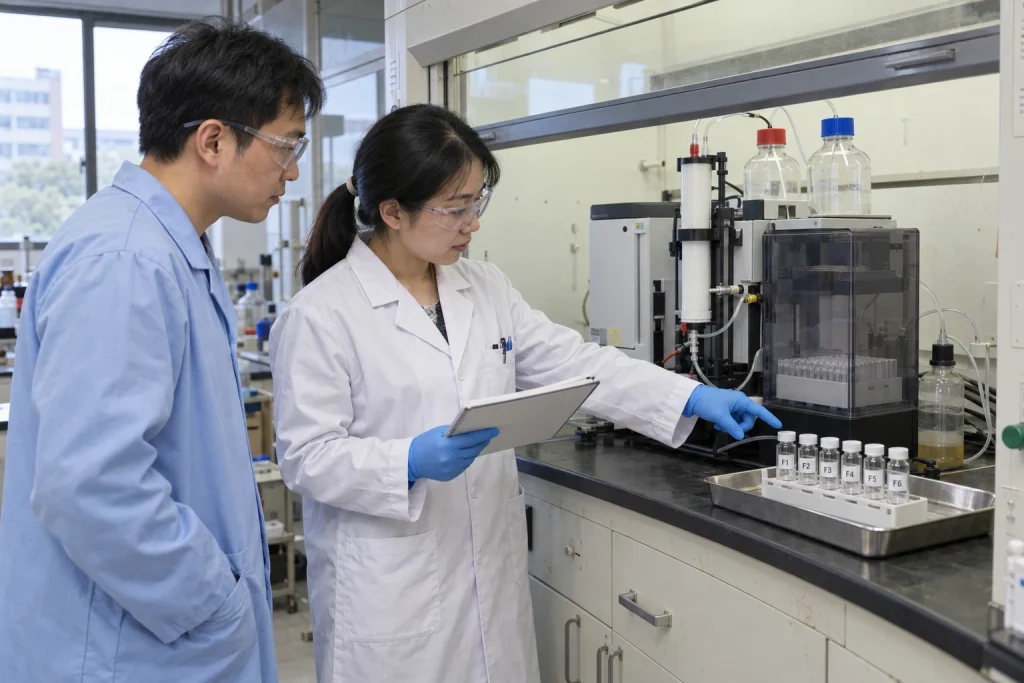
Sample preparation deserves equal attention. Incomplete dissolution, filtration losses, degradation in the sample solvent, or excessive sample concentration can distort a result. When supplier and buyer laboratories disagree, comparing preparation steps and integration settings may be more informative than repeating injections without changing the investigation.
Where GC Adds Useful Information
GC is commonly considered for volatile components that tolerate the analytical conditions. It may complement an HPLC related-substances method by examining residual solvents or other suitable volatile impurities. The main intermediate does not have to be measured by GC for a targeted GC solvent test to be useful.
Headspace sampling may be evaluated for residual solvent testing because it transfers vapor from a prepared sample vial to the instrument. Results depend on sample composition, equilibration conditions, calibration, and the behavior of each target solvent. A headspace method developed for one matrix should not be assumed suitable for a different intermediate without checking performance.
Direct injection may suit other samples, but volatility, thermal stability, and interactions with the inlet or column must be considered. A clean GC trace cannot establish the absence of nonvolatile impurities. Likewise, a clean HPLC ultraviolet trace cannot substitute for a targeted volatile-solvent assessment. Buyers should request the scope of each test rather than treating HPLC and GC as interchangeable purity labels.
Read Purity Numbers with the Method Attached
Chromatographic area percentage expresses a peak’s share of the integrated detector signal. It is not automatically a mass percentage or an assay. Different compounds can produce different responses, and components outside the method’s detection or integration scope may be omitted. Agilent’s explanation of area percentage calculations notes that this calculation uses no response factors and approximates relative amounts when components respond equally.
For purchasing comparisons, establish whether the reported value is area purity, calibrated assay, or another measurement, and whether results refer to material as received or a corrected basis. Water and inorganic residues generally require appropriate separate tests. A high organic peak-area result does not remove the need to assess them when they matter to downstream processing.
Request a representative chromatogram, method identifier, sample preparation summary, detector conditions, and reporting threshold. For quantitative impurity results, ask about calibration, quantitation capability, and relevant method performance. Numerical acceptance limits should follow the buyer’s process needs and supporting evidence, rather than being copied from an unrelated material specification.
Compare sample and commercial batches using an agreed method, and investigate unexpected new peaks or shifts before accepting them as routine variation. Our quality audit checklist for sourcing intermediates provides related procurement considerations. For overseas shipments, retain batch identifiers and agree how analytical questions will be resolved before dispatch.
Why AXIA CHEM
AXIA CHEM welcomes inquiries that connect the required intermediate with its intended synthesis and analytical expectations. Include the chemical identity, quantity, destination, requested documents, and any critical impurity concerns so that supply options, quality requirements, and timing can be discussed clearly. Confirm available testing and supporting documentation in writing for the specific offer. Contact AXIA CHEM about synthesis intermediate sourcing to begin that review.
Regulatory disclaimer: These products are supplied for research, formulation development, industrial and non-regulated applications. Final suitability for pharmaceutical, oral care, cosmetic, food-contact or biocidal applications shall be verified by the buyer according to local regulations. AXIA CHEM does not claim that any product is FDA approved, USP/EP certified, GMP grade or approved for any specific regulated end use unless otherwise confirmed in writing with supporting documentation.