
DL-panthenol vs D-panthenol is a purchasing decision that connects ingredient identity, formulation objectives and the form in which a material is supplied. Similar names do not make two grades interchangeable. For overseas buyers developing skin care, hair care or other formulations, a useful comparison starts with stereochemistry and ends with a controlled trial in the intended product. Price, handling and documentation should be assessed together, with performance claims supported by evidence relevant to the finished formulation.
DL-panthenol vs D-panthenol: Identity Comes First
DL-panthenol, CAS 16485-10-2, is the racemic form containing D- and L-panthenol. D-panthenol, also called dexpanthenol, has CAS 81-13-0 and represents the D-enantiomer. The distinction concerns the spatial arrangement of the molecule, rather than a different set of constituent elements. A purchase order should identify which form is required instead of relying on the word panthenol alone.
D-panthenol is the form associated with conversion to pantothenic acid, or vitamin B5. That biochemical distinction should not be turned into a blanket prediction about how every formulation will perform. Moisture retention, product feel and processing behavior also depend on the surrounding ingredients and the test conditions. DL-panthenol may be evaluated where its physical formulation contribution matches the development brief; D-panthenol can be considered when the specification explicitly requires the D-form.
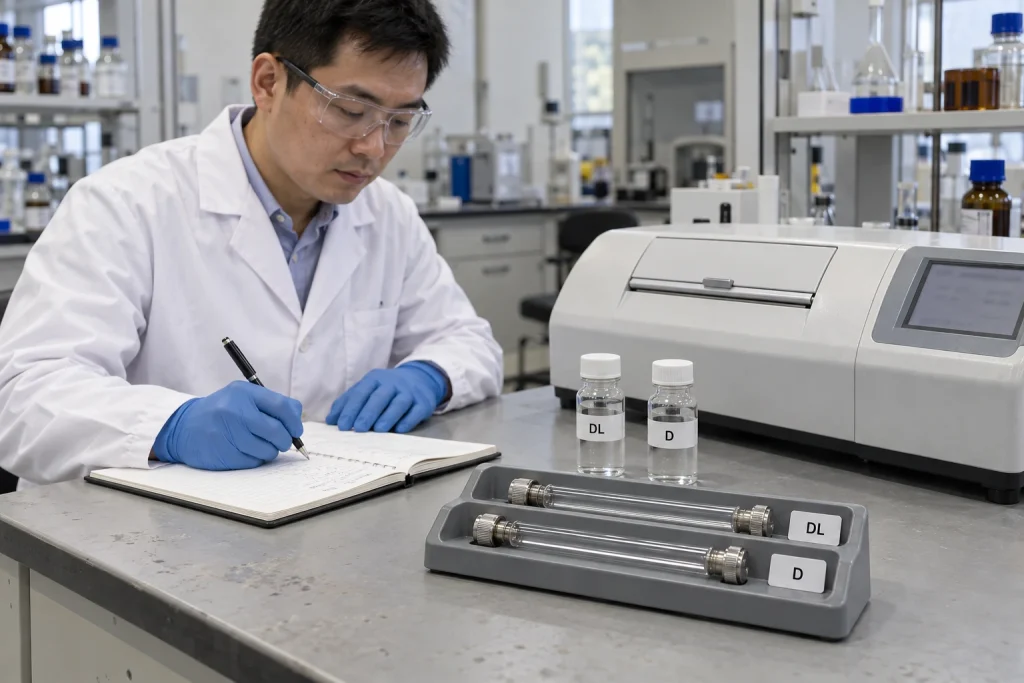
A routine total assay does not necessarily establish enantiomeric composition. If stereochemical identity is critical, ask which identity tests and methods support the supplier’s designation. Match the product label, specification, certificate of analysis and safety data sheet before approving a sample for development.
Compare the Supplied Grade and Active Basis
The practical comparison is between actual commercial grades, not names in isolation. Panthenol may be offered in different physical forms or as preparations with different active contents. Check whether a quotation covers a solid, a concentrated material or a solution, and identify any water, solvent or other declared components. Do not assume that every DL-grade or every D-grade arrives in the same form.
For a trial involving DL-panthenol, establish the stated assay basis and water specification before calculating the charge. An assay expressed on a dried basis cannot automatically be used as the active fraction of material weighed directly from the container. Ask for clarification when the analytical basis is missing or when the reported value and supply description appear inconsistent.
Compare delivered cost on a defined active basis, including any additional processing needed to introduce the ingredient. A convenient solution may reduce a dissolution step, while a solid may offer other logistical advantages. Neither advantage is universal. Packaging, dosing equipment, batch size and existing water balance determine which option is easier to use. Obtain quotations against the same specification and commercial terms so that price differences remain interpretable.
Build a Controlled Formulation Comparison
Start with the intended function and acceptance criteria. A moisturizer development project may examine hydration-related performance and sensory properties, while a hair care project may consider conditioning feel and compatibility with the base. These are evaluation objectives, not guaranteed outcomes. Avoid choosing an ingredient solely because another formulation used the same name or because a supplier describes a broad application category.
Run comparisons in the same base and document the amount of active panthenol introduced. Account for water or carrier introduced by each supplied grade. Keep mixing conditions, addition sequence and other ingredients consistent wherever feasible. When a change in supply form requires a different incorporation procedure, record that difference so the results can be interpreted fairly.
Follow the specific grade’s technical guidance for incorporation and storage. Check dissolution, appearance, odor, viscosity and pH, then monitor the finished formulation under conditions appropriate to its intended distribution. For shipments serving Gulf markets, distinguish transport exposure from recommended storage conditions rather than assuming that a single room-temperature observation represents the whole supply chain.
Evaluate the complete formulation, including its packaging and preservation system. Replacing one panthenol grade with another does not establish equivalent stability or microbiological robustness. Our DL-panthenol formulation guide for skin and hair care provides related considerations for planning the broader development review.
Define Purchase Specifications Before Scale-Up
A clear specification links laboratory approval to repeat purchasing. Agree on identity, assay method and basis, water content, appearance and any additional parameters relevant to the process. Where applicable, discuss impurity information and microbiological specifications. Acceptance limits should follow the buyer’s intended use and validated requirements, rather than being copied from an unrelated grade.
Request a representative sample with traceable batch documentation. Record the supplier, grade designation and batch used for qualification, and define how future changes will be communicated. Retain enough information to investigate a later difference in dissolution, color or finished-product behavior. A certificate of analysis is most useful when its test methods and reporting basis are understood by both parties.
For international procurement, confirm pack size, container closure, shelf-life statement, storage instructions and available shipping documents before ordering. Review the ingredient alongside other formulation performance ingredients in the development program. Ingredient identity alone does not establish that a particular supplied grade is suitable for a regulated end use or that a finished-product claim is justified.
Why AXIA CHEM
AXIA CHEM offers a point of contact for discussing DL-panthenol sourcing requirements and aligning a quotation with the buyer’s development brief. Send the required identity, assay basis, quantity, packaging preference and destination together so technical and commercial questions can be addressed clearly. Ask for current specifications, available batch documentation and sample arrangements before approving a supply decision.
A practical sourcing discussion should cover quality expectations, order planning and the response needed when a technical question arises. Confirm availability and lead time for the requested grade in writing. To discuss a sample or purchasing specification, contact AXIA CHEM about DL-panthenol sourcing.
Regulatory disclaimer: These products are supplied for research, formulation development, industrial and non-regulated applications. Final suitability for pharmaceutical, oral care, cosmetic, food-contact or biocidal applications shall be verified by the buyer according to local regulations. AXIA CHEM does not claim that any product is FDA approved, USP/EP certified, GMP grade or approved for any specific regulated end use unless otherwise confirmed in writing with supporting documentation.