
Choline chloride grades are not interchangeable, and the difference usually shows up only after the first full container is unloaded. The same molecule – choline chloride, CAS 67-48-1 – reaches the market as a free-flowing powder on a corn cob carrier for poultry feed, as a 70 or 75 percent aqueous solution for industrial synthesis, and as a clay-control additive blended into water-based drilling and completion fluids. Carrier, assay basis, moisture, residual amine odor and packaging all change with the intended end use. This guide compares the three commercial families side by side so buyers can specify the right one the first time.
What Actually Separates Choline Chloride Grades
Choline chloride is a small hydroxyl-functional quaternary ammonium salt (C5H14ClNO). In pure crystalline form it is a white, strongly hygroscopic solid that is highly soluble in water. Industrially it is most often produced from trimethylamine with ethylene oxide and hydrochloric acid, or by quaternization of trimethylamine with 2-chloroethanol, which is why residual trimethylamine and its characteristic fishy odor are among the first things experienced buyers check.
Because the pure salt absorbs atmospheric moisture so readily, very little of the world market moves as high-assay crystal. Instead the product is stabilized either by dissolving it in water or by adsorbing it onto a solid carrier. That single physical decision is what creates the grade families below, and it drives assay declaration, shelf life, freight cost and customs classification at the same time.
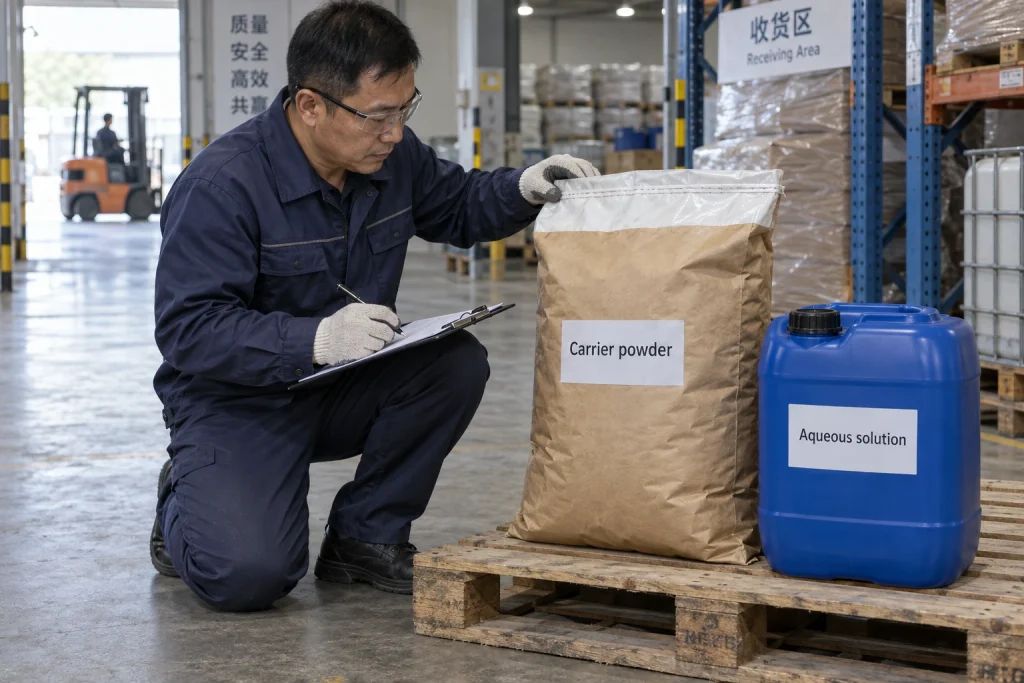
- Solution grades – typically declared around 70 to 75 percent choline chloride in water, shipped in drums or IBCs.
- Carrier powders – commonly declared at roughly 50 to 60 percent active content on corn cob (plant-derived) or silica carriers, shipped in lined bags.
- High-assay crystal – reserved for laboratory, research and specialty synthesis work where carriers and water cannot be tolerated.
Feed Grade: Carrier Choice Drives Everything
Feed applications are the largest single outlet. Choline is an essential nutrient for poultry and swine, and choline chloride is the usual way it is delivered in compound feed and premixes. For this use, buyers rarely argue about the molecule and argue constantly about the carrier.
Corn cob carrier is the traditional choice and is generally preferred where a plant-derived matrix is required or where the finished feed specification restricts mineral carriers. Silica carrier tends to flow and blend more predictably and is often selected for premix operations running automated dosing. Both are supplied as powders, and both should be assessed on declared active content, moisture, particle size consistency and caking behavior after transit through hot, humid ports. Buyers in the Gulf in particular should discuss summer sea freight conditions before fixing packaging, a point covered in more detail in our note on choline chloride for poultry feed in the GCC.
Two practical checks are worth writing into the purchase specification: the basis on which active content is declared (as-is versus dry basis), and the acceptable limit for free trimethylamine, which is the main driver of odor complaints at the feed mill.
Industrial and Technical Grade Applications
Outside animal nutrition, choline chloride is normally bought as a 70 or 75 percent aqueous solution. The most discussed industrial route in recent years is its use as a hydrogen bond acceptor in deep eutectic solvents, where choline chloride combined with urea, ethylene glycol or carboxylic acids forms low-melting mixtures that may be evaluated as alternatives to conventional organic solvents in extraction, electrodeposition and materials processing. Work of this kind is still largely at development and pilot scale, so specification stability between batches matters more than headline assay.
Choline chloride is also used as a chemical building block, and in some markets as a plant growth regulator, subject entirely to local agricultural registration. For solution grades the parameters that repay attention are assay by titration, water content, pH of the solution, color, free amine and iron or other metal pickup from storage and transfer equipment. Iron in particular can be introduced after manufacture, so a clean certificate of analysis does not by itself guarantee clean material on arrival.
It is worth noting where choline chloride does not compete. It is a small, hydrophilic quat with no meaningful surfactant character, so it does not substitute for long-chain cationics in emulsification or antimicrobial duty, and it is not a phase transfer catalyst. Where a genuine catalytic quat is required, buyers typically move to a different chemistry such as tetrabutylammonium bromide (TBAB), which sits in a separate part of our formulation and performance ingredients range.
Oilfield Grade: Clay Control and Shale Inhibition
In water-based drilling, completion and fracturing fluids, choline chloride can be considered as a clay stabilizer and shale inhibitor, and it is commonly explored where potassium chloride is restricted by discharge rules or where high salt loading is undesirable. Service companies normally take it as a concentrated aqueous solution for direct blending on location.
Oilfield buyers tend to specify differently from feed buyers. Freezing point and low-temperature handling of the solution, compatibility with polymers and biocides already in the fluid package, chloride contribution to the overall brine, and drum or IBC integrity for field transport usually outrank marginal differences in assay. Field performance is also formation-specific, so laboratory screening against the actual shale sample remains standard practice rather than optional. Our article on choline chloride as a shale inhibitor in water-based drilling fluids covers that evaluation sequence in more depth.
Specification Points to Confirm Before Ordering
Whichever family applies, the same short list prevents most disputes. Confirm the declared assay and the method behind it. Confirm the carrier or solvent and the moisture specification. Confirm the limit for free trimethylamine. Confirm packaging, net weight per unit and stacking behavior for the actual shipping route and season. Confirm the documentation set required at destination, since feed, industrial and oilfield consignments frequently need different paperwork even when the chemistry is identical. Finally, agree the retained sample and re-test arrangement in advance; for a hygroscopic product, an unresolved argument about whether moisture was gained before or after loading is an expensive one.
Why AXIA CHEM
AXIA CHEM supplies specialty and fine chemicals to industrial buyers across the Middle East and wider export markets. We work from your written specification rather than a stock datasheet, confirm carrier, assay basis and packaging before the order is placed, and supply a batch certificate of analysis with every shipment. Samples can be arranged for laboratory evaluation ahead of commercial quantities, and our team responds to technical and commercial queries within one working day. If you are comparing choline chloride grades for a feed, industrial or oilfield program, contact our team with your target specification and destination and we will quote against it directly.
Regulatory disclaimer: These products are supplied for research, formulation development, industrial and non-regulated applications. Final suitability for pharmaceutical, oral care, cosmetic, food-contact or biocidal applications shall be verified by the buyer according to local regulations. AXIA CHEM does not claim that any product is FDA approved, USP/EP certified, GMP grade or approved for any specific regulated end use unless otherwise confirmed in writing with supporting documentation.