
Static electricity is a quiet but costly problem in polymer processing and textile manufacturing. Dust pickup on moulded parts, sheets that cling during converting, yarn that clings to guides, and discharge risks near solvents all trace back to the same cause: insulating surfaces that hold charge instead of dissipating it. Cationic surfactants are one of the oldest and most widely used answers to that problem, and quaternary ammonium salts in plastics and in textile finishing remain a mainstream option for buyers who need a cost-effective, well-understood antistatic chemistry.
This guide outlines how these materials work, where they fit in compounding and finishing, and what specification points matter when you source them.
Why Polymers and Fabrics Build Up Static Charge
Polyolefins, styrenics, polyesters and most synthetic fibres are electrical insulators. During extrusion, winding, carding, cutting or simple handling, contact and separation between surfaces transfers charge, and an insulating substrate has no path to release it. The charge sits on the surface until it attracts dust or discharges abruptly.
Antistatic additives work mainly by increasing surface conductivity. Most low-molecular-weight antistats are amphiphilic: a polar head group attracts and holds atmospheric moisture at the surface, while a hydrophobic tail anchors the molecule in or on the substrate. The thin, ion-containing moisture layer that forms gives charge somewhere to go. Because the mechanism depends on humidity, performance of this additive class is generally evaluated across the humidity range the finished part will actually see, not only in a conditioned laboratory.
Internal and External Antistats: Quaternary Ammonium Salts in Plastics
Compounders usually distinguish two routes. Internal antistats are dosed into the melt during compounding and rely on gradual migration to the surface, which gives longer-lasting but slower-developing performance. External antistats are applied topically, by spray or dip from an aqueous or alcoholic solution, and give immediate effect that can be lost to washing or abrasion.
Cationic quats are more common in the external route and in film or sheet treatment, while ethoxylated amines and glycerol esters dominate many internal polyolefin applications. Where cationic chemistry is selected, short- to medium-chain trimethylammonium salts such as dodecyltrimethylammonium chloride (DTAC), CAS 112-00-5, are typical candidates because they are water-soluble and substantive to polar surfaces. Longer-chain products such as hexadecyltrimethylammonium bromide (CTAB), CAS 57-09-0, are more surface-active and may be considered where stronger adsorption on the substrate is wanted.
Two practical limits should be kept in mind. First, thermal stability: quaternary ammonium halides can degrade at the temperatures used for engineering thermoplastics, so melt-phase use is normally restricted to lower-temperature processes or confirmed by thermal screening. Second, surface effects: excess additive can bloom, reduce gloss, or interfere with printing and adhesion. Both points are best settled by trial on the actual formulation rather than by transferring a dosage from another substrate.
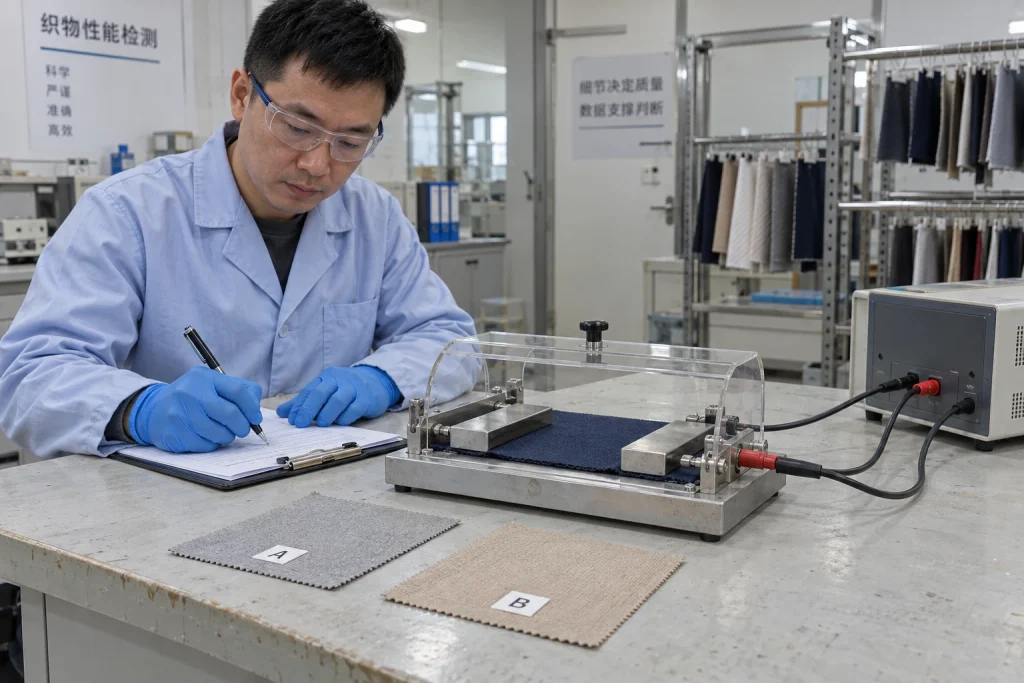
Antistatic Finishes for Textiles
In textile processing, cationic quats are applied as part of finishing baths and softener systems, often alongside the same chemistries used for hand and lubricity. The cationic head group binds to fibre surfaces that carry a net negative charge in water, which is why these actives are substantive to cotton and to many synthetics after wet processing. The result is reduced cling and easier handling downstream, and the softening and antistatic functions frequently come from the same class of molecule – the overlap explained in our note on quaternary ammonium compounds in fabric softener formulations.
Formulators should watch for interaction with anionic species. Cationic quats and anionic surfactants, dyes or sizing agents can form insoluble complexes that precipitate in the bath and reduce the effect of both components. Sequencing the process steps, rinsing between them, or selecting a non-ionic co-surfactant is the usual way around this.
Specification Points to Check Before You Buy
Antistatic performance claims mean little without a consistent raw material behind them. The parameters most often specified for this class are:
- Active content / assay – commonly determined by two-phase titration; state whether the figure is on an as-supplied or dry basis.
- Water content – many quats are hygroscopic, and moisture shifts both the assay and the handling behaviour of solid grades.
- Free amine and residual alkylating agent – indicators of how completely the quaternisation was driven and of downstream odour or colour risk.
- Inorganic halide – residual salt from synthesis, relevant where corrosion of processing equipment is a concern.
- Colour and odour – visible defects transfer directly to light-coloured film, sheet or fabric.
- pH of aqueous solution – affects bath stability and compatibility with the rest of the finish.
Surface resistivity or charge decay testing on the finished article is the only meaningful confirmation of effect. Values commonly cited as static-dissipative fall broadly between 10^6 and 10^12 ohms per square, but the target depends on the application and the test standard, and it should be agreed with the end user rather than assumed.
Handling, Storage and Regulatory Notes
Solid quats should be kept in tightly closed containers away from humidity, since caking and assay drift are the usual consequences of poor storage; the general principles are covered in our guide to quaternary ammonium salt storage and shelf life. Aqueous solutions should be protected from freezing and from prolonged heat.
On the regulatory side, cationic surfactants are aquatic-toxicity relevant, so effluent from padding or spray operations may need treatment before discharge depending on local rules. Where the treated article contacts skin, food or drinking water, the applicable national or regional requirements govern, and any claim of biocidal action carries a separate registration burden in most markets. Antistatic function should be positioned as a physical surface effect, not as an antimicrobial one, unless the product is registered for that purpose. Buyers who want an overview of the wider product family can browse our formulation and performance ingredients range.
Why AXIA CHEM
AXIA CHEM supplies quaternary ammonium salts and related cationic surfactants to compounders, textile chemical houses and formulation blenders across the Middle East, Africa and Asia. We work from the specification you actually need – active content basis, moisture limit, packaging format – rather than pushing a single standard grade, and we supply representative samples with batch documentation so that trials run on the same material that will be shipped in bulk. Multiple qualified production sources, consolidated export documentation and fast technical response on specification questions keep evaluation cycles short and repeat orders predictable.
Tell us the substrate, the process temperature and the performance target, and we will propose suitable candidates with a COA and sample for evaluation. Contact the AXIA CHEM team for pricing, specifications and lead times.
Regulatory disclaimer: These products are supplied for research, formulation development, industrial and non-regulated applications. Final suitability for pharmaceutical, oral care, cosmetic, food-contact or biocidal applications shall be verified by the buyer according to local regulations. AXIA CHEM does not claim that any product is FDA approved, USP/EP certified, GMP grade or approved for any specific regulated end use unless otherwise confirmed in writing with supporting documentation.