
Hexadecyltrimethylammonium bromide, better known as CTAB or cetrimonium bromide, is offered by suppliers across a wide quality spectrum, and CTAB purity grades are the first thing a technical buyer should clarify before comparing quotations. The same CAS number covers material destined for mesoporous silica templating in a university laboratory and material dosed by the drum into a textile or personal care plant. Both can be perfectly correct products, yet they are not interchangeable, and the difference rarely shows up in the headline assay figure alone. Understanding what a grade designation actually controls is what keeps a sourcing decision from becoming a failed batch.
CTAB is a cationic surfactant with a single sixteen-carbon chain on a trimethylammonium head group, CAS 57-09-0. It is water soluble above its Krafft temperature, which is reported to sit near ambient conditions, so cold storage rooms and unheated warehouses in cooler months can leave a nominally clear solution cloudy or partly crystallised. That single physical property explains a large share of the handling complaints that get misdiagnosed as purity problems.
What CTAB Purity Grades Actually Describe
A grade name is a commercial label, not a regulated definition. When a supplier quotes 99 percent minimum, the number usually refers to assay by two-phase titration against sodium dodecyl sulphate, which measures cationic active content rather than a single molecular species. Homologues with fourteen or eighteen carbon chains titrate almost identically to the target C16 molecule, so a high titration assay does not by itself confirm a narrow chain-length distribution. For most industrial duty that distinction is academic. For nanoparticle and templating work it is often the decisive variable.
The parameters that separate one grade from another in practice are free amine content, residual alkyl halide, water content, alkali and alkaline earth metal ions, heavy metals, and colour in solution. A supplier who can report these consistently is describing a controlled process. A supplier who can only report assay and appearance is describing a commodity.
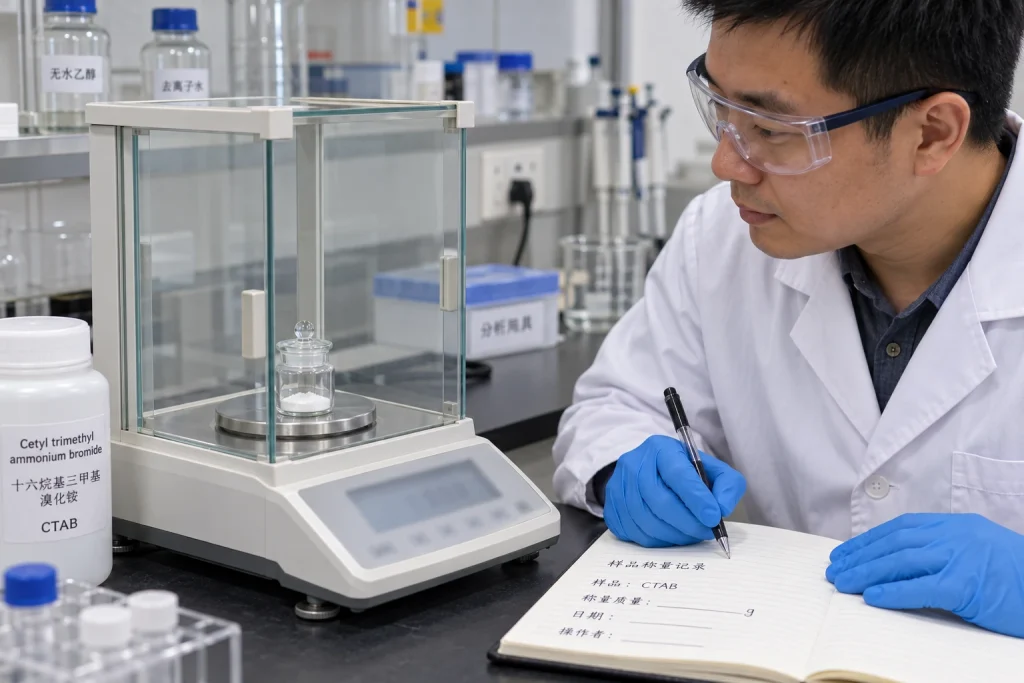
Materials Research Requirements
In materials synthesis CTAB is not a processing aid but a structure builder. It directs the pore architecture of MCM-41 type mesoporous silicas, stabilises the growth of gold nanorods, and templates a range of ordered inorganic frameworks. In these roles the surfactant micelle is the mould, so anything that perturbs micelle geometry or adsorbs competitively on a growing crystal face can be seen in the product.
Researchers working on seeded nanorod growth have long reported that results can vary between nominally equivalent lots from different sources, and trace impurities in the surfactant are among the explanations commonly explored. For that reason a research-oriented grade should be purchased against a specification that includes chain-length distribution or at least a tight homologue statement, low iodide and low free amine, and controlled metal ion limits. Lot reservation matters as much as the specification itself: when a laboratory finds a lot that performs, it will usually want to secure the remainder of that batch rather than reorder blind. Our overview of CTAB in materials synthesis covers the application side of this in more detail, and related templating chemistry sits within our zeolite and advanced material chemicals range.
Industrial Applications and Where Technical Grade Fits
Industrial users buy CTAB for a different set of reasons. It can be evaluated as a cationic conditioning agent in hair care, as an antistatic and softening component in textile processing, as an emulsifier or phase stabiliser, and as an antimicrobial active in certain cleaning and hygiene formulations subject to local registration. Here the functional requirement is surface charge and chain length in bulk, not molecular uniformity.
A technical grade with a solid assay, controlled water content and consistent colour will usually perform well in these applications at a materially lower cost than a research grade. What still matters is batch-to-batch consistency, because a formulation validated on one lot has to reproduce on the next. Buyers moving volume should focus their specification effort on the parameters that drive their own process: water content if the product is dosed gravimetrically into an anhydrous system, colour if the finished article is sold on appearance, and free amine if odour is a concern. Where a shorter chain length is preferred for foaming or solubility reasons, dodecyltrimethylammonium chloride is a common alternative to consider alongside CTAB.
Specification Points to Confirm Before You Order
Regardless of grade, ask for a recent certificate of analysis rather than a template, and confirm the test method behind each figure. Assay without a stated method is not a specification. Water content should state Karl Fischer or loss on drying, since the two do not always agree on a hygroscopic quat. Ask whether the reported metal ion figures come from routine testing or from a periodic validation, and whether packaging is lined to protect against moisture pickup during sea freight to humid ports.
Finally, align the grade with the true requirement. Buying a research specification for a textile line wastes money; buying a technical grade for nanorod synthesis wastes development time, which is usually more expensive. The correct question is not which grade is better but which parameters your process is actually sensitive to.
Why AXIA CHEM
AXIA CHEM supplies hexadecyltrimethylammonium bromide (CTAB) to customers across the Gulf, wider Middle East and international markets, with specification review before the order is placed rather than after the container lands. We work with buyers to match the grade to the application, provide current certificates of analysis for the lot being offered, support sample evaluation ahead of commercial quantities, and hold batch information so that a validated lot can be traced and repeated where inventory allows. Documentation for import clearance is prepared with the shipment, not chased afterwards, and technical questions are answered by people who can read a COA.
To discuss grade selection, request a sample or review a specification for your process, contact the AXIA CHEM team.
Regulatory disclaimer: These products are supplied for research, formulation development, industrial and non-regulated applications. Final suitability for pharmaceutical, oral care, cosmetic, food-contact or biocidal applications shall be verified by the buyer according to local regulations. AXIA CHEM does not claim that any product is FDA approved, USP/EP certified, GMP grade or approved for any specific regulated end use unless otherwise confirmed in writing with supporting documentation.