
Buyers comparing CPC monohydrate vs anhydrous cetylpyridinium chloride are usually looking at two grades that share the same active cation but differ in how water is bound into the crystal. That single difference changes the assay you see on the certificate of analysis, the amount of material you weigh out to hit a target active concentration, and the way the solid behaves in storage. For procurement teams and formulators sourcing quaternary ammonium surfactants, understanding which form is quoted – and why – avoids costly mismatches between a purchase order and a formulation sheet.
Two Solid Forms of the Same Cationic Surfactant
Cetylpyridinium chloride is a pyridinium-based quaternary ammonium compound built from a hexadecyl (cetyl) chain attached to the pyridine nitrogen, paired with a chloride counterion. The cationic head and the long hydrophobic tail give it the classic surfactant profile that has made it a long-standing member of the quat family.
The anhydrous form carries CAS 123-03-5 with a molecular weight of approximately 339.99 g/mol. The monohydrate carries CAS 6004-24-6 with a molecular weight of approximately 358.01 g/mol, reflecting one molecule of water of crystallisation per molecule of CPC. The monohydrate is the form most often isolated and shipped commercially, because it crystallises readily from aqueous systems and is straightforward to filter and dry to a stable solid. The anhydrous grade is generally produced by driving that water off under controlled drying conditions.
It is worth stressing that these are not two different chemistries. Once either grade is dissolved in an aqueous or hydroalcoholic system, the cetylpyridinium cation in solution is identical. The distinction is a solid-state and mass-accounting one, not a functional one at the molecular level.
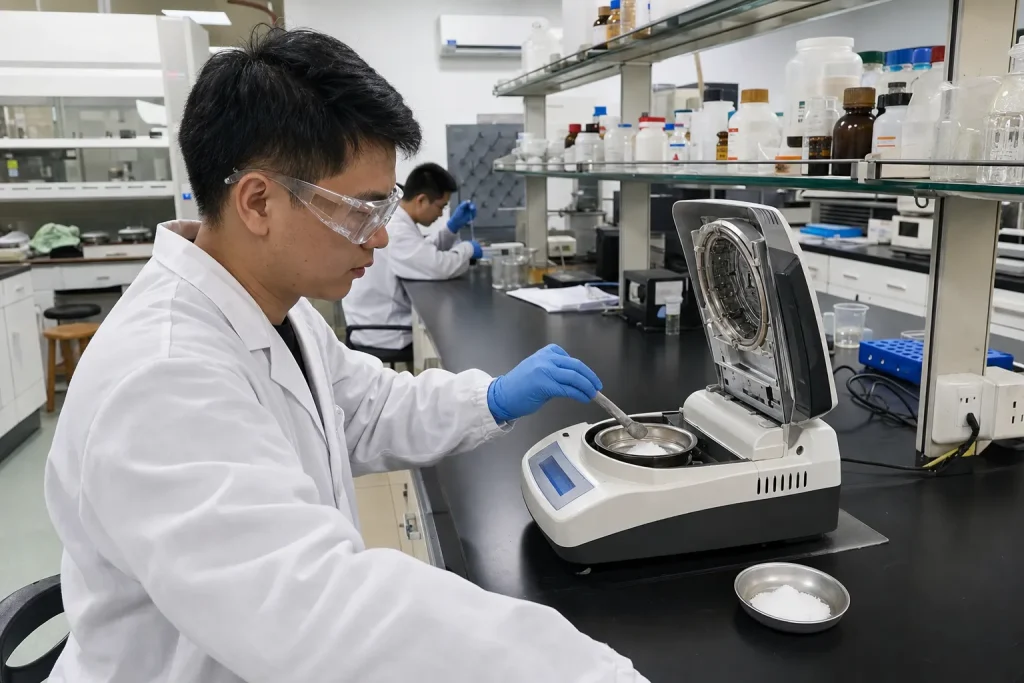
CPC Monohydrate vs Anhydrous: Assay, Molecular Weight and Water Content
The most practical consequence is arithmetic. Water of crystallisation accounts for roughly 5 percent of the mass of the monohydrate (18.02 divided by 358.01). That means one kilogram of monohydrate delivers about 950 grams of anhydrous CPC equivalent. A formulation calling for a defined active level must correct for this, or the finished batch will land below target.
This also explains apparent discrepancies between certificates of analysis. A monohydrate specification is commonly written on an anhydrous or dried basis, so a stated assay of 99 percent or higher may sit alongside a water content of around 4.5 to 5.5 percent by Karl Fischer titration. An anhydrous grade, by contrast, will show a much lower water figure. Two documents can therefore look inconsistent while describing perfectly conforming material – the difference is the reporting basis, and buyers should always confirm which basis a supplier is quoting before comparing assays or prices across offers.
Loss on drying and Karl Fischer results should be read in that same light. For the monohydrate, a water result near the theoretical value is expected and is not an impurity indication. For anhydrous material, a rising water figure may instead suggest moisture pickup during handling or storage.
Handling, Solubility and Storage Differences
Both grades are white to off-white crystalline solids that are soluble in water and in lower alcohols. In practice, the monohydrate is often described as the easier material to handle: the bound water contributes to a stable, well-formed crystal that resists the caking and clumping sometimes seen when a dried quat is exposed to ambient humidity.
Anhydrous CPC is hygroscopic in character and can take up atmospheric moisture, which may gradually shift its water content and, with it, its effective assay. Where an anhydrous grade is specified, tightly closed containers, dry storage, and minimising open exposure during dispensing can be considered standard precautions. Repeated opening of a large drum for small withdrawals is worth avoiding; sub-packaging into smaller units may be evaluated where frequent sampling is expected.
Both forms should be kept in sealed containers away from heat and direct sunlight, and handled with appropriate personal protective equipment, since cationic surfactants of this class can be irritating to skin and eyes. Segregation from anionic surfactants in storage and in shared equipment is also commonly explored as good practice, because cationic and anionic species can interact and form insoluble complexes.
Selecting a Form and Verifying the Specification
For most liquid-phase work – anything where the material is dissolved before use – the two grades are functionally interchangeable once the mass correction is applied, and the choice may come down to availability, price on an active basis, and local handling conditions. The monohydrate is often the default where humidity is a concern or where the material is stored for extended periods before use.
An anhydrous grade may be considered where the process is genuinely water-sensitive, where a solvent system tolerates no added moisture, or where a downstream specification is written specifically against the anhydrous CAS number. Applications across surfactant systems, personal care and oral care concentrates, industrial cleaning formulations, and laboratory or research use can be evaluated for either grade, subject to the buyer’s own qualification work.
Before placing an order, it is worth confirming a short list of points with the supplier: which CAS number is being supplied, whether assay is reported on an as-is or dried basis, the specified water content range and test method, appearance and melting range, packaging type and net weight basis, and the documentation package available. Aligning these at the enquiry stage is far simpler than reconciling them after material has landed. Buyers building a broader portfolio in this space often review adjacent grades across the quaternary ammonium salts range, where several cationic surfactants share comparable handling considerations, as well as related specialty fine chemicals used in the same formulations.
Why AXIA CHEM
AXIA CHEM supplies cetylpyridinium chloride in both monohydrate and anhydrous forms, with specifications confirmed in writing before order confirmation so that the assay basis and water content are unambiguous from the outset. Our team works from a stable manufacturing base with batch-level quality control, and we provide certificates of analysis with each shipment.
We focus on responsiveness that industrial buyers can plan around: fast technical replies to specification questions, clear lead time commitments, flexible packaging from sample quantities through to bulk drums, and export documentation prepared for Middle East and international destinations. Where a customer needs a trial quantity before committing to a production order, we can accommodate that.
If you are weighing the monohydrate against the anhydrous grade for a specific formulation, send us the target active level and the storage conditions you expect, and we will quote both on a comparable active basis. Contact the AXIA CHEM team to request a specification sheet, a sample, or a firm quotation.
Regulatory disclaimer: These products are supplied for research, formulation development, industrial and non-regulated applications. Final suitability for pharmaceutical, oral care, cosmetic, food-contact or biocidal applications shall be verified by the buyer according to local regulations. AXIA CHEM does not claim that any product is FDA approved, USP/EP certified, GMP grade or approved for any specific regulated end use unless otherwise confirmed in writing with supporting documentation.